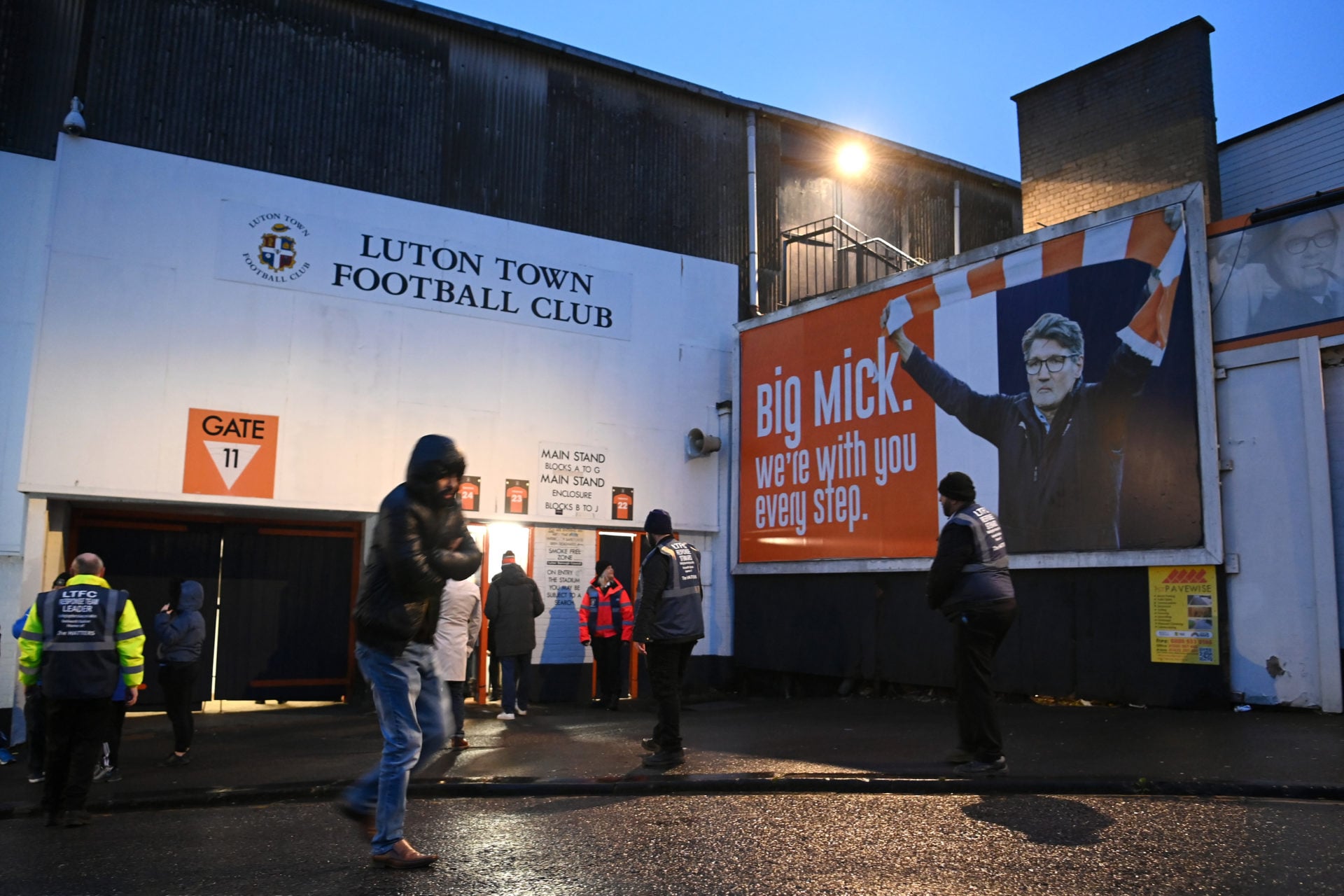

Luton Town are standing on the brink of an historic achievement if they can defy the odds and reach the Premier League.
No football team has ever won promotion from the fifth tier of English football, or the National League, as it is currently known, and then gone on to reach the Premier League, since promotion from the National League to the Football League was introduced, rather than teams simply being elected from the non-league game, in 1987.
If Luton Town manage to win promotion this season, they will not only become the first team in the entire history of English football to have done that, they will have managed it in less than ten years.
The English footballing landscape is about as rocky, harsh, and uneven as Elephant Island, with even more highs and lows. Even within this barbarous and quite often brainless climate, one league reigns supreme. The Championship is a division in which all but five teams spend more than their entire turnover on wages alone. That is to say nothing of transfer fees, infrastructure projects, and every other form of expenditure. It is a plainly unsustainable set of circumstances which has been created by teams throwing the kitchen sink at promotion, with dreams of reaching the promised land of the Premier League and all of the riches that come with it.
Of course, only three teams can win promotion from the Championship each season, which means most of them don’t get to unlock those riches, so instead they slide further and further into debt, owed either to their owners or even worse to a bank, or even worse still to some corporate equivalent of a payday lender, and that is why we see a number of Championship teams in trouble at the moment. Derby County are the most notable example, having been docked 21 points this season and currently in administration, owing more than £60 million, but they are far from alone when it comes to English football’s house of cards.
Within all of this madness, however, Luton Town have somehow managed to climb to third place in the Championship, behind only Fulham and Bournemouth at the time of recording, two teams with budgets four or five times larger than theirs, less than eight years on from their last season in the fifth tier of English football. Only once have Luton spent more than £1 million on a player over the course of their rise, yet they find themselves above teams who have multiple players who cost more than £15 million. It is a lesson, some would argue, in how to run a football club, and an all too rare example of the fact that there is another way.

During their heyday, which came during the late 1950s, Luton finished eighth in the First Division, above the likes of Manchester United, Chelsea, and Arsenal, and they reached the final of the FA Cup in 1959, where they lost 2-1 to Nottingham Forest in front of 100,000 spectators. Within six years of that famous Wembley defeat, Luton suffered three relegations and found themselves in the basement division of England’s football league pyramid, competing with the likes of Aldershot and Southport, rather than finishing above Manchester United.
And in some respects, that kind of collapse has always been in Luton Town’s DNA. A team of booms and busts. Who often overachieve, given that they have never had the biggest stadium or the biggest budget, but always seemed to be just a couple of steps away from catastrophe. After the club was relegated from the First Division in 1992, just before the creation of the Premier League, it took them less than a decade to drop all the way down to the Football League’s bottom division once again. Within four years of that they were back in the Championship, and then from 2006-07 to 2008-09, Luton suffered the fastest possible descent through the Football League, enduring three successive relegation campaigns.
The last of those three relegations, in 2009, which saw Luton lose their league status, bringing an end to an 89 year reign for the Hatters within the Football League, hit by far the hardest of the lot, and left the club with a bitter taste in the mouth. The Hatters actually amassed 56 points in the 2008-09 season, which would have been enough to give them a 15th place finish in League Two, were it not for a 30 point deduction. That is the heaviest points deduction ever imposed upon a Football League team in England. Initially, Luton were docked ten points during pre-season, and were fined £50,000, as the result of an FA investigation which found that they were guilty of 15 misconduct charges.
That was a hefty blow in of itself, to a club that was already in disarray, but then the Football League piled on the misery, telling Luton’s new supporter-backed consortium owners that they would only be granted permission to compete in the upcoming campaign if they accepted a further 20 point deduction for leaving administration without agreeing to a CVA with their creditors. Luton appealed against the decision, but their appeal was thrown out, and before a ball was kicked, their fate was all but sealed. Thirteen years later, there is still a banner that can be seen at Kenilworth Road on a Saturday afternoon which reads, ‘Luton Town. Established 1885. Betrayed By The FA 2008’.
Luton fans felt as though an example was made of them, but instead of wallowing in despair and letting that sense of injustice eat away at them, they harnessed those grievances, channelling that sentiment to create a siege mentality and a really close bond between everyone at the club which has galvanised and spurred them on ever since.

That spirit was present even during the 2008-09 season, when Luton’s relegation was made inevitable by their points deduction, as manager and club legend Mick Harford took his team to the new Wembley Stadium in April 2009, where they came from behind to beat Scunthorpe United 3-2 in the final of the Football League Trophy. Of the 55,000 fans at Wembley that afternoon, roughly 40,000 of them were supporting Luton, and they used the venue and occasion to stage a massive protest against the FA and the Football League.
In lifting the trophy, Luton became the first team to win the Football League Trophy and be relegated from the Football League during the same season, and were therefore unable to defend their title the following season. The club did request that they be allowed to defend their crown in the National League, but again, the Football League refused.
Whilst Hartford had been able to harbour an unbreakable team spirit, that ran beyond the first team dressing room and right throughout the club, and Luton had been taken over by the fan-backed Luton Town Football Club 2020 consortium in January 2008, with significant ties to the Luton Town Supporters’ Trust, their predicament was still an extremely difficult one. Coming off the back of six years of chaos that began with John Gurney’s 2003 takeover of the club, Luton had basically sold anyone who earnt anything or was worth anything of note over the last two or three years.
The Conference, as it was then, or the National League now, may be seen as rock bottom for previously competitive Football League teams, but time and time again we see just what a tough league it is to get out of. In the 2009-10 season alone, Luton would have to compete with former Football League teams like Oxford United, Wrexham, and Mansfield Town, along with newly-promoted AFC Wimbledon, FC Wimbledon’s phoenix club.
Wrexham have been stuck in the Conference for 14 years now, it took Lincoln City and Grimsby Town six seasons to get back into the Football League, and Grimsby have since dropped back out again, meanwhile Cambridge United, who competed alongside Luton in the 1992-93 First Division campaign, were stuck in the Conference for nine years. What’s more, a number of former Football League teams, such as Stockport County, who were relegated from League Two in 2011 and within two years found themselves competing in the National League North, go to show that the fifth tier, quite literally, isn’t rock bottom – and that is to say nothing of teams who dropped out of the league and just went bust.
So Luton knew that it would be tough, and so it proved. Following relegation, ten players departed on free transfers, meanwhile 19 came in, all but one of them either on a free or on a loan deal. A run of three defeats in the space of five games in September, given the expectations Luton put on themselves, saw Mick Harford lose his job.
What makes the National League, or the Conference, such a difficult division to get out of, is the fact that there aren’t just lots of very professional and competitive clubs vying for promotion, there are only two promotion places available to the 24 clubs. Only the title winners are guaranteed promotion, with the other promotion place decided via the play-offs. Luton finished as Conference runners-up during their debut campaign, but lost 2-0 to York City in the play-off semi finals. This would become a bit of a recurring theme for the Hatters, who finished in the play-offs, but ultimately could not win the play-offs, in each of their first three seasons in the Conference. In the 2010-11 season, it was AFC Wimbledon who got the better of them in the final on penalties, and a year later, unbelievably, it was York City once again who crushed Luton’s dreams at Wembley Stadium in front of 40,000 fans. As with the Football League Trophy final, it should be said, around 30,000 of those fans were supporting the team in orange, but this time, they would leave Wembley Way feeling disappointed.
Following three failed play-off campaigns, the 2012-13 campaign was a concerning one for Luton, as they slipped to 7th, finishing 13 points off the play-offs. In February 2013, manager Paul Buckle was sacked, and Dagenham & Redbridge boss John Still left the League Two side to drop into the Conference with Luton. Still was, at the time of his departure, the longest serving manager in the Football League, but following nine years at the club, he felt undermined when the Dagenham board sold striker Dwight Gayle to Peterborough United without his permission.

Still is a man who deserves immense credit when it comes to the rise of Luton Town. At a time when the club could be seen as stagnating, he implemented a complete overhaul of the first team squad and of their methods. During the close season, he released twelve players and signed eleven new ones. Among the new arrivals was Pelly Ruddock Mpanzu, who joined Luton on-loan from West Ham, before agreeing to a permanent deal in the January transfer window. More than eight years later, and having just turned 28, Mpanzu is still at Luton, he has made 32 appearances in the club’s promotion charge this season, and if the Hatters were to win promotion, as far as I can make out, Mpanzu would become the first player in the history of English football to go from level five to level one of the Football League, in order, at the same club. It would be a monumental achievement, and already, the fact that he has gone from the Conference to the Championship at Kenilworth Road, is a remarkable achievement.
The John Still revolution worked, and striker Andre Gray scored 30 goals as Luton avoided their nemesis, the play-offs, and instead romped to the title, amassing an enormous 101 points, almost 20 clear of league runners-up Cambridge United. It brought an end to a five-year stay in non-league football, and it also made John Still the first manager to have taken three different teams out of the non-league game, and he described it as “the most remarkable season ever.”
Luton were dealt a pretty major blow following promotion, when striker Andre Gray departed for Brentford. For Still, it was an all too familiar tale of losing his star centre-forward, but it was, in fact, evidence that the Luton model was working. The club’s owners, Luton Town Football Club 2020 Ltd, were adamant that Luton would never again fall into the kind of trouble that led to their demise during the 2000s. That meant a sharp focus on models of sustainability, meaning the occasional player sale was inevitable. It also meant that strong attendances and fan buy-in was essential. When the Luton Town Football Club 2020 Ltd consortium acquired Luton in January 2008, they did so with the blessing of the Luton Town Supporters’ Trust, who also own 50,000 shares in the club. In addition to their ownership stake, the Supporters’ Trust holds a veto over any major changes to the club’s identity. Key to Luton’s strategy moving forward would be to bring on board as many local people as possible and to feel a real sense of pride and community about their football club.
Luton is a town which has attracted plenty of unwanted media attention surrounding extremists of all stripes. The radical Islamist group Islam4UK, led by the later jailed hate preacher Anjem Choudary, had active cells in Luton and staged a number of controversial rallies and protests in the town. One such protest in Luton, in 2009, staged against British soldiers, led to the creation of the far-right English Defence League, led by Stephen Yaxley-Lennon, who is better known in Britain by the alias Tommy Robinson. I don’t want to get too tied up within the weeds of Luton’s various strains of extremism, whether that be Islamofascists or just straight up old fashioned fascists, but over the years, there have been times when Luton Town has been associated with more hard right and particularly anti-Muslim views, such as those espoused by the EDL. Tommy Robinson was a member of Luton’s hooligan firm, known as the MIGs, which stands for ‘Men In Gear’, and even authored two books about his experiences with the group, alongside such noted titles as ‘Enemy Of The State’ and ‘Mohammed’s Koran: Why Muslims Kill For Islam.’
Although these associations tainted Luton from the outside, and certainly those fringes did exist at the football club, they did not resonate with the experiences of the average Luton Town fan. Nonetheless, it turned a lot of South Asians in particular, and others no doubt, away from the club. Over 20% of Luton’s population are of either Pakistani or Bangladeshi descent. There could not be a Luton Town Football Club which claimed to represent the local community without those groups. So Luton’s new owners sought to rid the club of their associations, or perceived associations at least, with the far right and with hooliganism. In 2014, the club launched a campaign named, ‘From Headscarves to Football Scarves’, which was a scheme intended to make women of South Asian descent feel more welcome at games.
Kick It Out described the campaign as a success, and encouraged other clubs to follow in Luton’s footsteps, and not since 2018, when CEO Gary Sweet told a small pocket of supporters to stop chanting Tommy Robinson’s name, has the club made headlines for all the wrong reasons. Whilst some club’s see their support dwindle following relegation from the Football League, Luton had a higher average attendance in the Conference in the 2013-14 season than they had six years earlier playing in League One, and their attendances during their first season back in League Two eclipsed those of their last season in the Championship.

During their first season back in the Football League, despite losing Andre Gray to Brentford and attempting to replace him from within, Luton enjoyed a terrific first half of the season. On Christmas Day, they were third, two points off the top of the table, and even by the middle of February they were still in the hunt for an automatic promotion place, just one point behind Wycombe Wanderers in third. Then came a run of seven successive defeats which scuppered Luton’s hopes of achieving back-to-back promotions to League One, and Still’s men carried that form into the following campaign. In December 2015, a year on from being in an automatic promotion spot, Luton found themselves 17th in League Two, and manager John Still, who still has the honorary freedom of the borough of Luton, was sacked.
In his place, Luton appointed Nathan Jones, who had previously been signed by Luton as a player, under David Pleat, in 1995, but never actually played for the club. Jones had no previous experience in first team management, other than having briefly acted as a caretaker boss at Brighton in 2014, and he was employed by the Seagulls as a first team coach when he was approached by Luton. As soon as Jones arrived, Luton started winning games again, and they ended the season up in 11th. Over the summer, just as John Still had done, Jones put his own mark on proceedings.
There was no ambiguity about Jones’ ambitions, it was promotion, and his recruitment reflected that fact, as the former Brighton coach targeted experienced players with League Two promotions already on their CV. In his first summer in charge, Jones brought in Danny Hylton from Oxford United, who scored 27 goals in his debut campaign, as Luton finished fourth in League Two, one place off automatic promotion, before losing to Blackpool in the play-off semi finals. Mark Cullen, who Luton had sold to Blackpool for over £200,000 the previous season, scored a hat-trick in the first leg. The following summer, Jones signed James Collins from Crawley Town. He would score 20 goals in his first season, as Luton won promotion from League Two, 25 goals in his second season, as Luton won the League One title, and 14 goals in his first season in the Championship.
That makes things sound very simple, when, in reality of course, it wasn’t. Just as Luton looked to be on course for back-to-back promotions from League Two to the Championship, Nathan Jones left the club to replace Gary Rowett at Stoke City. Stoke had underachieved since dropping into the Championship, with one of the best squads on paper, in the division, and no doubt Jones saw it not only as a hefty pay rise, but also a chance to take them up and manage in the Premier League. Luton appointed Mick Harford, or Mr Luton Town I suppose I should call him at this stage, as his replacement, in the hope that he could just come in, steady the ship, and keep Luton on track for promotion.
He did just that, as Luton were crowned champions of League One, but the Championship would prove to be by far the toughest test yet for both Nathan Jones and Luton Town. Jones won just three of Stoke’s last 21 games of the season, finishing 16th, and after that run was extended to only five wins in 35 games at the start of the following season, he was rather unceremoniously dismissed in November 2019.
Luton, meanwhile, not only decided to replicate their strategy of appointing a manager with no previous first team managerial experience, which had worked out so well for them last time out, they also decided to replicate appointing someone named Jones – as Graeme Jones, who had been out of work since losing his job as Darren Moore’s assistant at West Brom, was handed the top job. However, this time it wouldn’t work out. From January onwards, Luton didn’t once manage to get out of the relegation zone, and they spent almost that entire period dead last. In April, Graeme Jones was finally sacked, and Nathan Jones was brought back to Kenilworth Road.

Nathan replaced Graeme during the 2019-20 seasons unanticipated break, due to the COVID-19 pandemic, and when Nathan Jones came in, Luton were down in 23rd, six points from safety, and with the worst goal difference in the division with nine games to go. It was an almighty task, but the Hatters lost just one of those last nine games. They remained in the bottom three right up to the final game of the season, when they beat Blackburn Rovers 3-2 thanks to two own goals and a penalty, climbing 22nd to 19th, and ending up three points clear of the drop. It was a heroic climax to a season in which Luton for so long appeared to have been doomed.
Nathan Jones’ failure at Stoke, in many respects, might prove to be beneficial to both him and Luton in the long run. If you speak to most Stoke City fans, they have a pretty dim view of Jones, and seem baffled that he has managed to enjoy success of any kind elsewhere. He also didn’t seem to ingratiate himself with many Stoke City players, some of whom have even made their dislike of him fairly public. Broadly speaking, Jones was considered to be a bit of a caricature at Stoke, and a bit of a joke, but for Luton, it is almost as though, as still a fairly inexperienced manager, Jones learnt a lot, and got a lot of his mistakes out of the way in the Championship elsewhere, without it costing them, before returning to the club.
At Kenilworth Road, it is a perfect fit. Whilst Graeme Jones is obviously a very capable coach, there was an inferiority complex about the club during his tenure, as though they went into games not so much expecting to lose, but not always entirely convinced that they could win. A 7-0 defeat to Brentford, early on in his reign, perhaps didn’t help. Luton are a small club, by most metrics, in the Championship these days, but under Nathan Jones, they have beaten the likes of Norwich, Bournemouth, and West Brom, and they led twice against Chelsea before narrowly losing 3-2 in the FA Cup earlier this season. That has inspired great belief within the Luton squad that they are capable of going toe-to-toe with anyone, regardless of their budget or stadium, and that they’ve no one to fear in the Championship.
Just as important as his man management has been Luton’s recruitment ever since their demise in the late 2000s. Attempting to go from the non-league game to the Premier League without spending anything is a task sometimes attempted by people who play Football Manager, but rarely by clubs in real life.

Luton have utilised free transfers and loan deals expertly. At the big clubs, where they have such large academies, there are always some real gems among their cast offs every season, and Luton have found a useful habit of identifying some of the finest among them. Then you have players like James Bree, who would have been way out of Luton’s budget back when he joined Aston Villa for a reported fee of £3 million, said to be earning in excess of £10,000 a week. However, having played only 21 league games in three seasons at Villa Park, and having struggled to make an impression there, Luton were able to sign Bree on a permanent basis. How much he cost them was never disclosed, but some sources suggest that he may even have arrived on a free, just with favourable future bonuses and sell-on fees for Villa.
What unites almost all of Luton’s signings is that they are players with fire in their belly and a point to prove, and if they aren’t, they’re unlikely to stick around for long. Throw in the likes of Robert Snodgrass and Cameron Jerome, two players with promotions to and first team football in the Premier League on their CVs, and Luton have a great blend of youth and experience, which is one ingredient that tends to unite every team that has ever overachieved in the Championship. Most importantly though, Luton tend to sign good, solid characters who will fit into a really tightly-knit squad – one which has evolved gradually, rather than being completely overhauled, ever since the club’s success in League Two, meaning that ethos, and even still some of that bitterness about 2009, lingers in the dressing room, on the training ground, and drives the team on.
Luton’s only sizable signing was the recruitment of Croatian goalkeeper Simon Sluga in the summer of 2019, after the club won promotion to the Championship. Sluga set Luton back a reported club record £1.3 million, and after a really shaky start, during which time he dropped a handful of clangers, Sluga displayed his class at Kenilworth Road. He won the club’s Player of the Season award last season, before departing in the January window just gone to Ludogorets Razgrad in Bulgaria. Sluga had just six months remaining on his contract at Luton, but even still, the club still managed to get £500,000 for him, plus a string of clauses which means that, should he play and impress in the Champions League, they could even end up turning a profit on him.
Sluga was replaced by Jed Steer, but he suffered a nasty achilles injury shortly after arriving in Bedfordshire on-loan from Aston Villa, so James Shea, who has been with Luton since their time in League One, now finds himself starting games at Kenilworth Road once again. Whilst Luton have spent next to nothing, they have a handful of notable departures. James Justin and Jack Stacey alone, the club’s two most lucrative sales, both of whom departed in the summer of 2019 and both of whom play primarily at right-back, pocketed the Hatters more than £10 million. Earlier on in their rise, Luton sold the likes of Andre Gray, Mark Cullen, and Jack Marriott for substantial profits, at least for them at that time.
Whilst accounts haven’t yet been published for this season, Luton CEO Gary Sweet believes that the Hatters’ wage budget ranks among the three lowest in the division, and is certain that Luton have won the most points this season in relation to pounds spent. It is a record that the club is proud of.

Luton have been playing their home games at Kenilworth Road since 1905, and whilst it is one of the most charming and distinctive stadiums in the top two tiers of English football, at least if you like old stadiums like I do, it isn’t big enough to meet Luton’s ambitions. There has been talk of a new stadium at Luton Town for as long as most Hatters fans can remember, but a myriad of seemingly ever more unrealistic projects failed to come to fruition. John Gurney, a businessman who was once arrested and charged with conspiring to import cocaine before being acquitted at trial, outlined his intention to build a Formula One track around a 50-70,000 seater stadium with a removable pitch, suspended, by concrete stilts, above the M1 motorway back when he bought the club in 2003. Within 55 days of becoming chairman, Luton were in administration.
Now the plans are a little bit more modest, but also rather more realistic, and finally, it looks as though Power Court, as it has been named, is actually going to be built. The planned 23,000 capacity ground, fit for Premier League football, would more than double Luton’s home capacity, and would massively increase their revenue potential. Clearly there is a huge appetite for football in Luton, and the 9,931 spectators that the club has averaged over the course of this season is not only their highest average attendance since their last season in the top flight, back in 1991-92, it is also the highest attendance, as a percentage of a stadium’s capacity, of any team in the Championship.
The completion date for Power Court has been pushed back to 2024 at the earliest, and it is perhaps more likely to be 2025, which means that Kenilworth Road could well see Premier League football before it is knocked down. Indeed, it could well see Premier League football next season. Luton have won more points in 2022 than any other team in either the Premier League or the Championship. The play-offs have been familiar foes for Luton, even over the course of their rise, but if they can win promotion, it would be one of the finest fairytale stories that English football has ever conjured up.
However, perhaps even more importantly, if Luton don’t go up this season, unlike for many clubs in the Championship, it won’t be the end of the world. Luton are way ahead of schedule. If they make the play-offs, and get anywhere in them, that is just a bonus.
Luton Town are a football club who have had good times and bad times, but even during the very best of times, such as the late 80s and early 90s, you felt as though that success was built on flimsy foundations. That is no longer the case. Luton’s foundations are among the strongest in the Football League, and for a club whose crises appeared to be existential a little over ten years ago, that is more important than any promotion.
Receive exclusive football transfer news and updates twice a week to your mailbox