
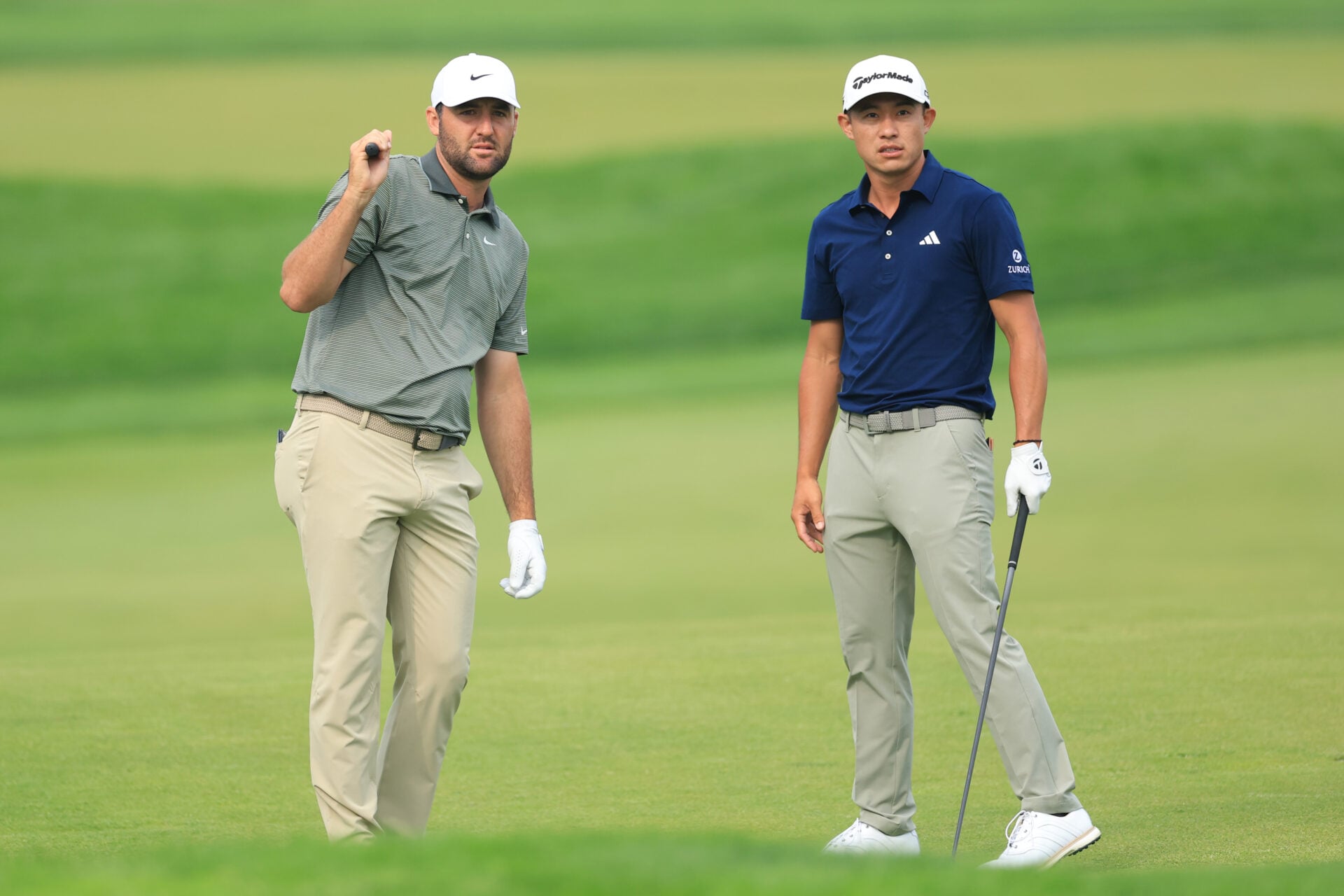

Scottie Scheffler shares what’s most important to him in the swing
Scottie Scheffler has become the PGA Tour’s gold standard for iron play, leading the strokes gained: approach category for three straight seasons and redefining what elite ball-striking looks like. His technique may appear unorthodox, but the precision and clubface control he produces are what make him the game’s most reliable iron player.
For amateurs, that means his advice carries enormous value. Scheffler’s guidance isn’t about swinging harder — it’s about creating repeatable, solid contact and making smarter decisions into greens.
Scheffler’s three tips to help amateurs hit their irons better
Cleaner, more dependable iron shots will naturally produce more greens in regulation and more birdie chances — the foundation of lower scores. Scheffler shared his first two pieces of advice with Golf Digest, while the third came during a TaylorMade clinic.

1. Prioritize solid contact over power
Many amateurs try to emulate a Tour pro launching a 7-iron 200 yards, but Scheffler insists that distance shouldn’t be the goal. “Quality of contact is the biggest difference between a Tour player and an amateur,” he says.
His starting point is the backswing: your arms should only travel as far as your body can rotate, with the back of the left hand matching the clubface. If your arms outrun your turn and the face opens, the downswing becomes a scramble to recover — and you lose the ability to strike the ball cleanly.
2. Stay relaxed to create rhythm and flow
Scheffler’s coach, Randy Smith, encourages him to treat the swing as a smooth build-up of speed culminating in a clean strike — not a violent move from the top. One way to achieve that is by keeping the lead arm soft, even with a slight bend at the top.
Relaxation prevents the common amateur error of yanking the club down aggressively. When you keep the tension low, the club moves naturally, helping you find the center of the face more often.
3. Play the highest-percentage shot into the green
Scheffler’s final tip revolves around strategy — and it may be the most important for amateurs. He always chooses the shot that maximizes his chances of simply hitting the green, even if it’s not the most aggressive option.
For example, if a front-right pin leaves him between clubs at 161 yards, he refuses to force the shorter option. “It’s easier to take something off a shot than it is to add yardage,” he explained. The goal is consistency, not perfection: choose the club that guarantees the ball carries the trouble and leaves a putt, not a recovery shot.
Receive exclusive football transfer news and updates twice a week to your mailbox