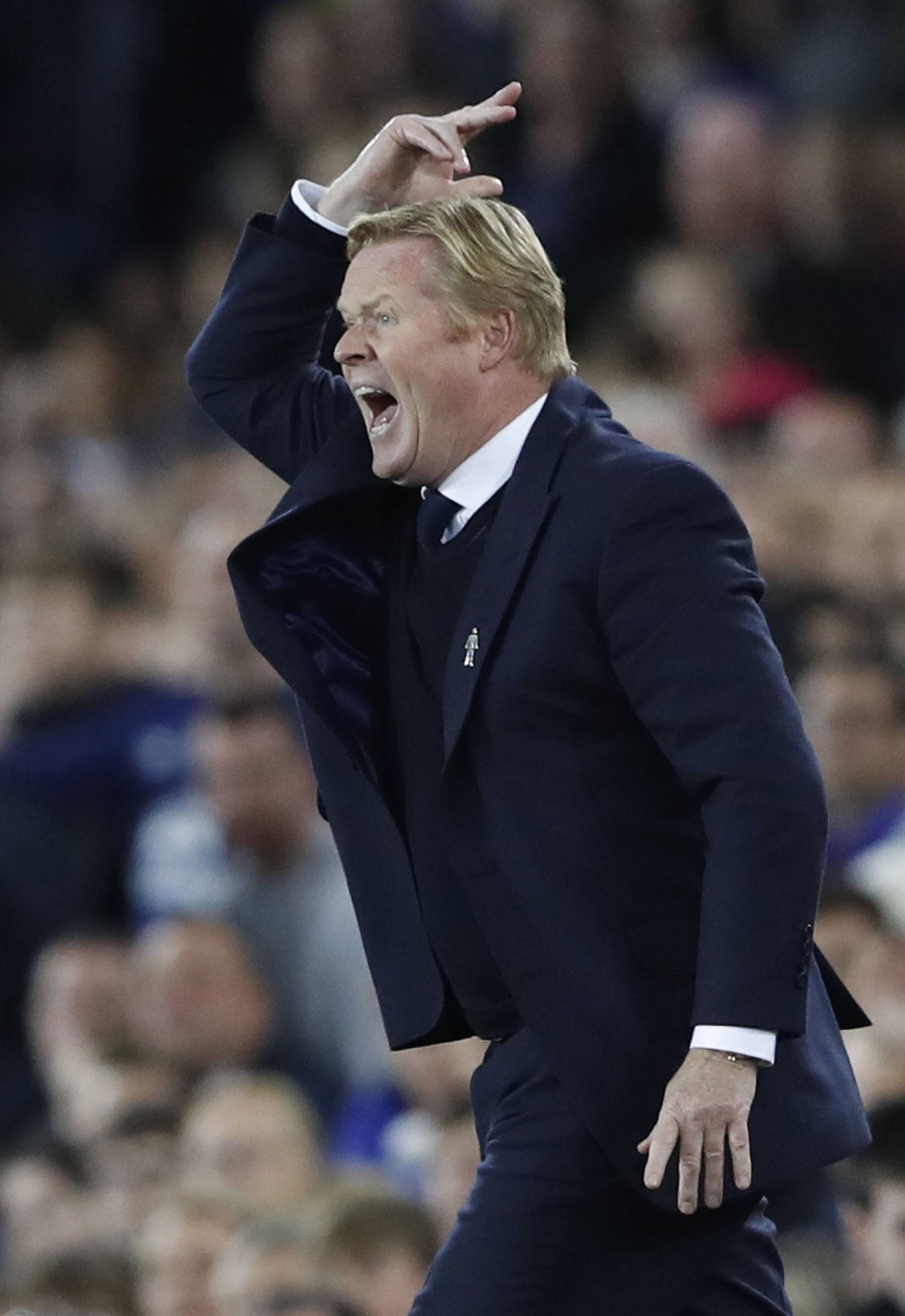

Is new Everton manager Ronald Koeman’s willingness to experiment with formations a blessing or a curse for the Toffees?

In his first seven Premier League games in charge, Ronald Koeman has overseen four wins, two draws and a loss. The 14 points he has accumulated from those games sees his new Everton side sitting in fifth place, above the likes of Manchester United and Chelsea (sixth and seventh respectively) on 13 points.
Thus far, the Dutchman has utilised three separate formations: 3-4-2-1, 4-2-3-1, and 4-3-3.
Of these three, it is clear that the 4-2-3-1 has been his preferred formation – after all, he deployed the same system when he was at Southampton.
However, he seemed to feel that the system lacked viability when he was unable to call upon Romelu Lukaku to play in the lone striker’s role.
As a result, he switched to a 3-4-2-1, using a fluid front three of Ross Barkley, Gerard Deulofeu, and Kevin Mirallas to make up for the Belgian’s absence. On paper, Deulofeu started centrally, with Barkley and Mirallas slightly behind and to his left and right respectively, but in reality, the three were given license to roam and interchange at will.
 This formation reared its head in the opening day 1-1 draw with Tottenham, and the 2-1 win over West Brom. It proved functional, if a little unorthodox, but the players were clearly not used to it. The system was clearly designed to make up for the absence of Lukaku via the attacking freedom of three players who weren’t natural strikers, and it worked well enough. Koeman’s tinkering allowed the club to earn a draw and a win where sticking to a 4-2-3-1 without a natural striker may have resulted in a loss and a draw, for instance.
But as soon as Lukaku was fit again, Koeman reverted to his preferred 4-2-3-1. He debuted it in the EFL Cup against Yeovil Town, easing Lukaku back from his injury, and it worked wonders. The Toffees ran out 4-0 winners against the League Two side, and advanced to the next round.
 He persisted with it for the next five games, winning the first three in the league. However, the fourth and fifth games ended in defeat.
The first loss came in the EFL Cup, where the system was used without Lukaku up front, and Everton fell to a 2-0 defeat against Norwich City, and were knocked out. Defensive mistakes were largely to blame for the defeat, but the lack of a tangible presence up front hampered their goalscoring potential against the Canaries as well.
However, the next game – a league fixture against Bournemouth – also resulted in defeat, despite Lukaku’s return to the starting line-up.
Perhaps losing two games in a row caused Koeman to feel the need to make changes, and he did so in their next game against Crystal Palace.
 He dropped Mirallas (a winger) for Tom Cleverley (a central midfielder), and switched to a 4-3-3.
They drew the game 1-1, but the formation change was not a positive one. For one thing, while the inclusion on an extra central midfielder gave them more control, it blunted them in attack. Secondly, the use of Ross Barkley as a winger – who often cut inside forcing Lukaku out wide in the process – produced mixed results. His best position is undoubtedly in a more central area, and it was telling that, at 1-1 and chasing the win, Koeman reversed his initial switch (bringing Mirallas back on for Cleverley) and reverting to a 4-2-3-1.
It is possible that the use of the 4-3-3 was a tactical decision made specifically for the game against Palace, knowing of their threat on the counter-attack and not wanting to over-commit men forward.
However, the switch did not produce the desired results, and it arguably cost them two points.
Koeman’s tactical tinkering often can be a blessing, earning Everton results where they might have lost. But on occasion, his tendency to tinker may result in overthinking and overcomplicating things when his tried and tested methods are a better bet.
There is no doubt he is an excellent and tactically astute manager, but he is still human, and sometimes, he will make mistakes.
Receive exclusive football transfer news and updates twice a week to your mailbox