
Netflix’s Formula 1 documentary series Drive to Survive is back for season 8 with a behind the scenes look at the dramatic 2025 season.
Drive to Survive season eight landed on Netflix on Friday, 27 February, just a week before Formula 1 returns for 2026 with the Australian Grand Prix, giving viewers one final chance to relive 2025.
Fans were spoiled for storylines last year. Lewis Hamilton’s blockbuster debut with Ferrari, Christian Horner’s dismissal from Red Bull after 20 years at the helm, and a gripping three-way title fight between reigning world champion Max Verstappen and McLaren duo Lando Norris and Oscar Piastri ensured there was no shortage of drama.
Yet the latest instalment of the hit series leaves plenty to be desired. Several defining moments from the 2025 campaign were overlooked in favour of filler footage promoting the F1 75 event and, later, the upcoming Brad Pitt F1 film.
Reduced from 10 episodes to eight, the new season does little to justify its shorter run time. Even with slightly longer episodes, Netflix’s coverage of 2025 feels incomplete.
While Drive to Survive remains an effective gateway for newer fans looking to catch up on the sport’s biggest narratives, it struggles to resonate with long-time supporters who lived through the season’s twists and turns in real time.
That said, the series still captures some of 2025’s most heart-warming and memorable moments, including Nico Hulkenberg finally securing his long-awaited first podium after 13 years in Formula 1, the now-iconic LEGO car race in Miami, and Carlos Sainz’s maiden podium for Williams.
But there were still glaring omissions. Here are five moments that should have featured in Drive to Survive season eight:
Norris suffers Zandvoort heartbreak as Isack Hadjar secures maiden F1 podium
One of the most glaring omissions from season eight of Drive to Survive was the Dutch Grand Prix, the first race back after the summer break.
Heading into Zandvoort, Lando Norris had begun to chip away at the points deficit to McLaren team-mate Oscar Piastri, who had won six races to the Briton’s four in the opening half of the season. The momentum was starting to shift, and the home of Max Verstappen felt like a pivotal battleground in the evolving title fight.
Although Norris qualified second behind Piastri, it was still a prime opportunity to keep his championship hopes firmly alive. For much of the race, he looked poised to do just that, remaining in a steady podium position.
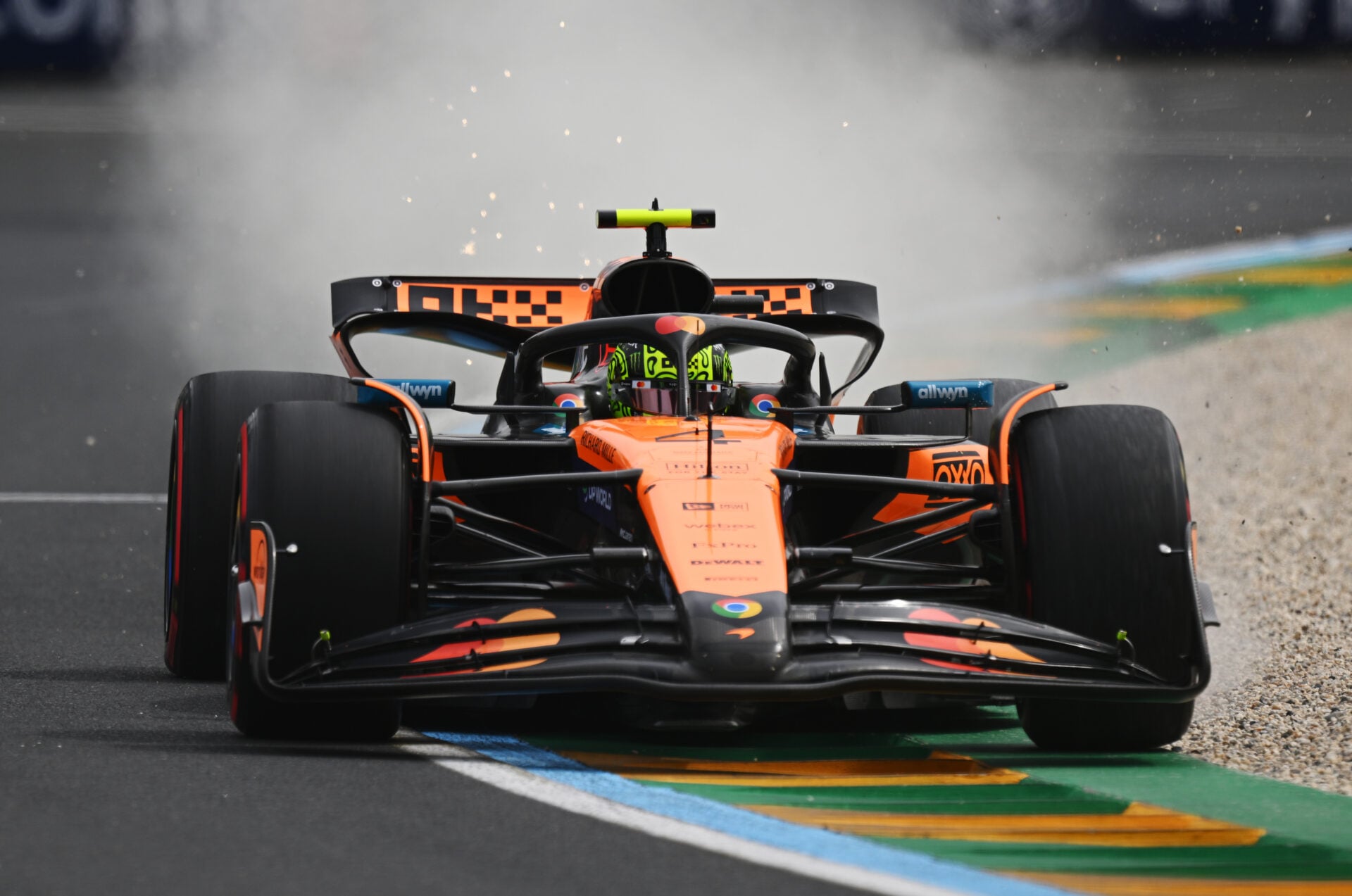
Then, with only seven laps remaining, disaster struck. Smoke began pouring from Norris’ McLaren, forcing the then 25-year-old to pull off at the side of the track. The images were brutal: a dejected Norris sitting in the Zandvoort sandbanks as his team-mate cruised to a seventh victory of the season, stretching the gap between them to a daunting 34 points.
The drama did not end there. Ferrari endured a nightmare afternoon that also went uncovered by Netflix. Lewis Hamilton crashed heavily at Turn 3, and 29 laps later Charles Leclerc was sent into the same barrier after contact with Kimi Antonelli, sealing a crushing double DNF for the Scuderia.
Viewers were also denied the chance to relive Isack Hadjar’s maiden Formula 1 podium, and Racing Bulls’ first since Pierre Gasly’s third-place finish at the 2021 Azerbaijan Grand Prix, back when the team was still known as AlphaTauri.
For a race packed with title implications, heartbreak and breakthrough moments, Zandvoort’s absence is difficult to overlook.
Max Verstappen admits costly ‘mistake’ in George Russell crash at Spanish Grand Prix
A defining flashpoint in the 2025 title fight arrived far earlier than many expected, when Max Verstappen was penalised for causing a collision with George Russell at the Spanish Grand Prix.
Looking back on the race at the Circuit de Barcelona-Catalunya, Verstappen later told Viaplay: “The only point of criticism is obviously Barcelona,” after surrendering what would prove to be a crucial nine championship points.
The drama unfolded during a rolling restart. Verstappen suffered a snap through the final corner, allowing Charles Leclerc to sweep past in his Ferrari. Sensing opportunity, Russell lunged up the inside at Turn 1. The pair made contact, forcing the Red Bull off the track before Verstappen rejoined ahead of the Mercedes.
Red Bull instructed their driver to hand the place back to avoid a penalty for leaving the track and gaining an advantage. But in the heat of the moment, tensions boiled over. Verstappen later admitted that everything “went red” before he made the “mistake” of driving into Russell as he appeared to let him through.
The stewards responded with a 10-second time penalty, dropping Verstappen from fifth to 10th at the chequered flag, a costly swing of nine points.
At the time, Verstappen trailed the McLaren drivers by over 40 points, and the setback seemed manageable as he didn’t appear to be in the fight. Yet as the season unfolded, those nine points loomed large. In the end, the Dutchman was denied a fifth world title by just two points to Norris, a margin that makes Barcelona impossible to ignore.
McLaren’s Singapore Grand Prix proves the decisive gloves-off moment
Tensions surrounding McLaren’s so-called ‘Papaya rules’ reached boiling point at the Singapore Grand Prix, after Norris launched an aggressive move on team-mate Piastri in the opening corners.
Norris made a lightning start, gaining two positions off the line before diving past his Australian team-mate for third. But the move came at a cost. A snap of oversteer through Turn 3 saw Norris clip Max Verstappen’s Red Bull ahead, before making contact with Piastri and forcing him towards the wall.
Piastri’s frustration was immediate. “Are we cool with Lando just barging me out of the way? I mean that wasn’t very team-like, but sure…” he said over team radio.
Despite the flashpoint, McLaren maintained their stance that both drivers were free to race. Piastri later described the situation as “not fair”, highlighting the growing strain within the garage.
By the time the paddock arrived in Austin two weeks later, Norris revealed the team had implemented “repercussions until the end of the season”, although he declined to elaborate on what those measures involved.
With just 22 points separating the pair in the championship after Singapore, the race felt like a genuine turning point, the moment the intra-team battle shifted from controlled competition to something far more combustible.
And the drama was not limited to McLaren. Drive to Survive also overlooked Fernando Alonso’s remarkable late-race charge towards Lewis Hamilton’s ailing Ferrari. The Aston Martin driver erased a 40-second deficit in the closing stages, closing to within four tenths of Hamilton at the chequered flag in one of the season’s most thrilling pursuits.
McLaren’s COTA collision that dragged Verstappen back into contention
Verstappen’s unlikely title defence received an unexpected lifeline at the United States Grand Prix Sprint, when both McLaren drivers crashed out at Turn 1.
Norris and Piastri lined up second and third on the grid, poised to strengthen their grip on the championship battle. Instead, their race unravelled within seconds of lights out.
Norris initially fended off an attack from Piastri on the run to Turn 1 at the Circuit of the Americas, but the Australian attempted a cutback on the inside of his team-mate. The move triggered a chain reaction: Sauber’s Nico Hülkenberg was squeezed between Piastri and Alonso’s Aston Martin, leading to contact between the McLaren and the Sauber.
The impact pitched Piastri into Norris, sending the Briton spinning and eliminating both papaya cars on the spot.
According to reports from Auto Motor und Sport, McLaren internally placed the blame on Piastri, while Sky Sports commentator Martin Brundle said: “I believe he was predominantly to blame.”
The double DNF proved costly. Both drivers haemorrhaged valuable championship points, and the incident appeared to dent Piastri’s confidence at a critical stage of the season.
Amid the chaos at McLaren, Verstappen quietly capitalised, cruising to Sprint victory and clawing back momentum in the title race. The drama did not end there either: a late collision between Lance Stroll and Esteban Ocon reshuffled the order further, allowing Carlos Sainz to secure a crucial Sprint podium for Williams.
For a weekend that dramatically shifted the championship narrative, its absence from Drive to Survive feels like another missed opportunity.
Max Verstappen’s stunning pit-lane to podium charge in Brazil
The Brazilian Grand Prix has delivered its fair share of unforgettable moments, and the 2025 race was no exception.
The Sprint race set the tone for a chaotic weekend. Oscar Piastri crashed out while running behind his McLaren team-mate, before Franco Colapinto and Nico Hülkenberg followed him into the same barrier. Later, Gabriel Bortoleto was launched airborne after colliding with Alex Albon on the pit straight, his Sauber skidding across Turn 1 and scattering debris across the circuit. Remarkably, the Brazilian rookie emerged unscathed, though the damage ruled him out of qualifying.
While Drive to Survive focused on Lewis Hamilton’s disappointing qualifying session in São Paulo, it glossed over Red Bull’s alarming lack of pace. Verstappen could manage only P16, with team-mate Yuki Tsunoda down in P19, a shocking result for the previously dominant team.
After exceeding his allocation of power unit components, Verstappen was forced to start Sunday’s race from the pit lane. What followed was one of the most remarkable recovery drives of his career.
The Dutchman sliced through the field in the opening laps, climbing to 13th before further chaos erupted ahead. A collision involving Piastri, Kimi Antonelli and Charles Leclerc on lap 5 shuffled the order once more. Despite suffering a puncture that required an early stop, Verstappen’s aggressive tyre strategy proved decisive.
By lap 30, the unthinkable had happened: Verstappen was leading the race. “I never thought I’d be saying this, Max, but from the pit lane you are now the race leader,” race engineer Gianpiero Lambiase told him.
“Not bad,” came the understated reply.
A second stop on lap 54 for fresh soft tyres armed Verstappen for a late charge. On lap 63, he swept around the outside of George Russell’s Mercedes to snatch third place in a bold, decisive move.
Although Drive to Survive captured his tense late-race battle with Antonelli, the Italian holding firm to secure second, the broader scale of Verstappen’s recovery was arguably underplayed.
From pit lane to podium, it was a drive that reignited his title bid and reminded the paddock exactly why he remained a championship force.
Receive exclusive football transfer news and updates twice a week to your mailbox