
Australia have qualified for the Round of 16 at a World Cup for only their second time after finishing second in Group D. So, what happened the last time they reached the knockouts?
The Socceroos are enjoying their sixth appearance on the FIFA stage and fifth in succession at Qatar 2022. Graham Arnold led the Oceanic nation to the World Cup by beating Peru on penalties 5-4 in the intercontinental play-off this June. The tie finished 0-0 after extra time.
Australia’s reward for goalkeeper Andrew Redmayne’s heroics was a place in Group D with Tunisia, Denmark and 2018 World Cup champions, France. They also met Les Bleus in their opening fixture. But despite Craig Goodwin breaking the deadlock, the Socceroos lost 4-1.

Australia qualify for the Round of 16 at the 2022 World Cup second in Group D
France’s dizzying attacking unit of Kylian Mbappe and Ousmane Dembele on either side of Olivier Giroud was too much for Australia. Yet the Socceroos rallied and edged Tunisia 1-0 through Mitchell Duke’s improvised header. Mathew Leckie then hit to beat Denmark 1-0.
Leckie twisted and turned Joakim Maehle inside out before slotting through the full-back’s legs and into Kasper Schmeichel’s net. His goal was ultimately enough to pip Tunisia as the runners-up to France in Group D. Even with the Eagles of Carthage beating Les Bleus 1-0.
Australia will now meet Group C winners Argentina in the Round of 16 at the 2022 World Cup. They will meet at Ahmad bin Ali Stadium in Al-Rayyan this Saturday, December 3. La Albiceleste went through after beating Mexico and Poland 2-0 but lost 2-1 to Saudi Arabia.
So, ahead of the Round of 16 tie between Argentina and Australia, HITC Football has taken a look back at the last time that the Socceroos made the knockout stages at a World Cup…
Australia made their only previous Round of 16 appearance at the 2006 World Cup
Australia made their only previous appearance in the Round of 16 at a World Cup in 2006 in Germany. The Socceroos had crashed out in the group stage on their tournament debut in 1974 in West Germany. They would also fall at the first hurdle in 2010, 2014 and 2018.
Making the knockout stages in 2006 marked a huge accomplishment for Australia on their return to the World Cup after 32 years. But it was a feat the Oceanic nation did not repeat in their following appearances before Qatar 2022. It was also where their 2006 run ended.
The Socceroos pipped Croatia to finish second to Brazil in Group F in 2006
Like for Qatar 2022, FIFA drew Australia to face the reigning World Cup champions in their group at Germany 2006. Brazil won their record fifth and most recent title in 2002 in Japan and South Korea. They would also meet Japan and Croatia during the group stage in 2006.
Japan were the first team waiting for Australia on their return to the FIFA stage after their 32-year hiatus. The Samurai Blue also ensured Guus Hiddink’s Socceroos did not get off to an ideal start. Shunsuke Nakamura broke the deadlock in Kaiserslautern after 26 minutes.
Yet the midfielder’s goal was not without a slice of fortune as Atsushi Yanagisawa seemed to impede Mark Schwarzer as he sought to collect Nakamura’s hopeful cross. But Egyptian referee Essam Abdel Fatah overlooked Australia’s protests and allowed the goal to stand.
It seemed like the referee’s decision would settle the game as the final whistle loomed, as well. But Tim Cahill came off the bench to drill a loose ball home from close range after 84 minutes. He would also fire home from 18 yards out with just one minute left on the clock.
John Aloisi then ensured Australia would kick the 2006 World Cup off with a win as he fired home in injury time. Brazil, meanwhile, began their campaign with a 1-0 win over Croatia. The 2007 Ballon d’Or winner, Kaka, provided the only goal at the Olympiastadion in Berlin.

Brazil put an end to Australia’s celebrations in their second game in 2006
A match with the reigning World Cup holders, Brazil, followed for Australia in their second fixture at Germany 2006. But the Selecao put an end to the Socceroos’ celebrations at the Allianz Arena in Munich. Adriano and substitute Fred got the goals on 49’ and 90 minutes.
Hiddink set Australia up to defend well and their organisation caused Brazil problems for much of the early exchanges. Selecao great Ronaldo Nazario created the opening Adriano needed to break the deadlock just after the break, though, as he slotted in from 18 yards.
Harry Kewell enjoyed a chance to draw the Socceroos level soon after but blazed over an unguarded net. Mark Viduka’s attempted chip also landed on top of Dida’s net before Fred put the game to bed. The forward finished after Robinho’s effort came back off the post.
The win was enough for Brazil to secure their place in the Round of 16 at the 2006 World Cup with a game to spare. While for all of Craig Moore’s efforts at the back and superbly-timed tackle to deny Ronaldo, Australia went to Stuttgart needing a result against Croatia.

Kewell came to the Socceroos’ rescue to seal the runners-up spot in Stuttgart
Australia and Croatia would create a piece of World Cup history during their Group F clash in Stuttgart. The game was just the fourth on the FIFA stage to ever feature three red cards as English referee Graham Poll sent Dario Simic, Josip Simunic and Brett Emerton each off.
Poll showed all three players a second yellow card in the late stages as the teams fought to advance. Simic was the first to walk for Croatia in the 85th minute before Simunic followed in the 93rd minute. Emerton had seen Poll reduce Australia to 10 men in the 87th minute.
Before anyone walked, though, there were four goals with Darijo Srna netting the opener for Croatia inside the second minute. The midfielder beat Zeljko Kalac with a precise free-kick. But Moore would draw Australia level after 38’ with a penalty for Stjepan Tomas’ handball.
The Socceroos set up camp firmly in Croatia territory from the moment they fell behind. Yet Niko Kovac would put Vatreni back in front 11 minutes after the break as Kalac failed to anticipate the midfielder’s tame strike. His error forced Australia to go all-out in attack.
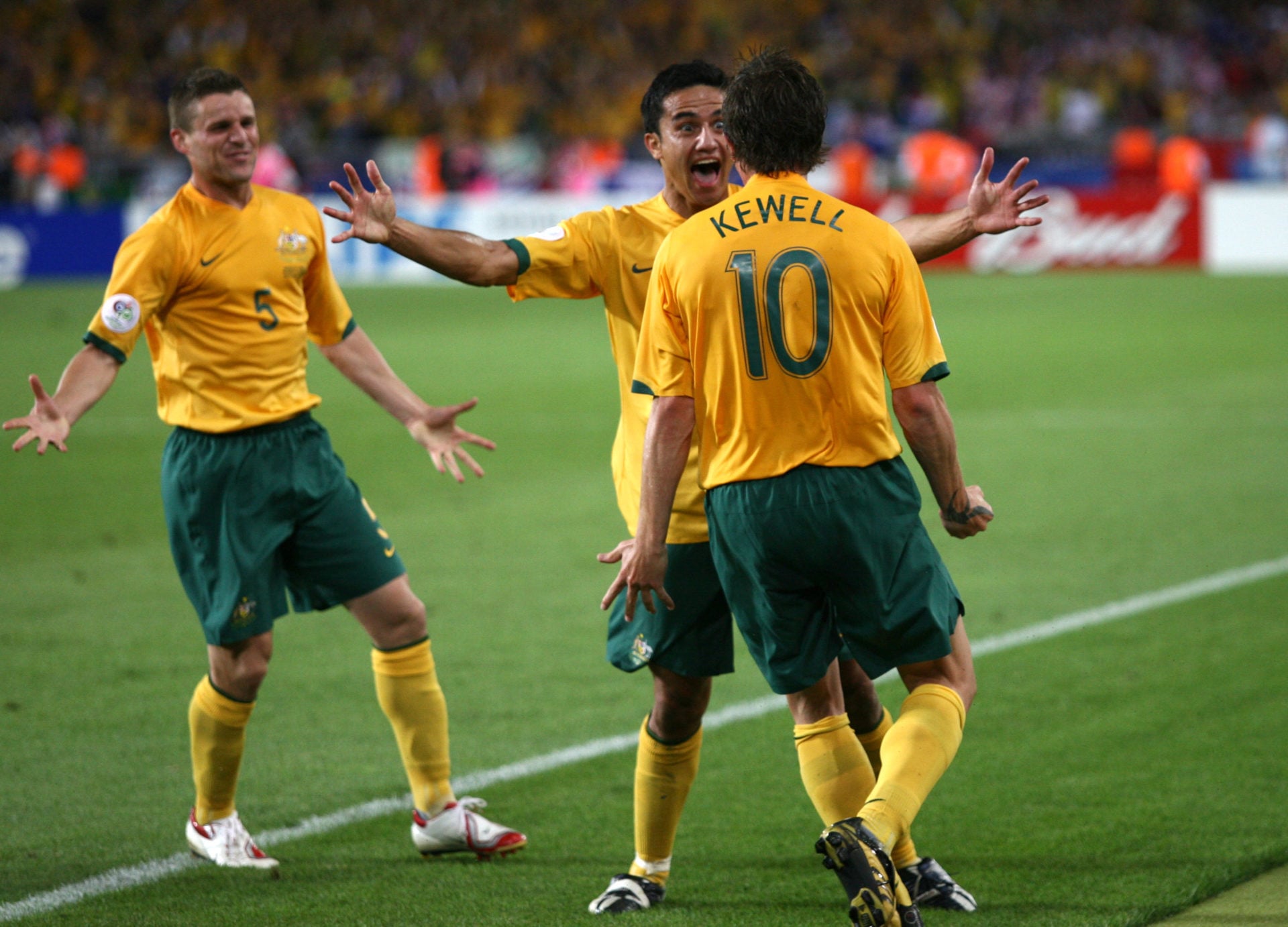
Eventually, Kewell came up with the goods when he met John Aloisi’s flick-on from Marco Bresciano’s cross. Everton hero Cahill then thought he had the winning goal, but Poll had already blown for full-time. Much to Simunic’s anger, which forced his third yellow card.
Poll had already shown Simunic two yellow cards during the game but failed to show the defender a red card. The official would eventually reach for his back pocket after the final whistle. The calamitous error saw FIFA cut short Poll’s duties officiating at Germany 2006.

Another referee would prove integral to the result as the Socceroos met Italy
A 2-2 draw with Croatia was enough for Australia to pip Vatreni for the runners-up spot to Brazil. The Socceroos reached the Round of 16 at the 2006 World Cup with four over two points. Were it Leeds United hero Kewell’s goal Poll ruled out, Hiddink’s squad were out.
Italy would await Australia in the first knockout round match at the Fritz-Walter-Stadion in Kaiserslautern. And, unfortunately for the referee, Spaniard Luis Medina Cantalejo would find himself central to the result. First, he questionably sent Marco Materazzi straight off.
Cantalejo reached for his pocket for a foul on Bresciano that might not have warranted a red card for another referee. The dismissal saw both teams tighten up during a match that had already seen Luca Toni come close to breaking the deadlock. He was Italy’s best threat.
Toni added bite to an otherwise toothless Azzurri unit but should have done better with a header that went just wide. Schwarzer also stopped the striker’s later attempt after Toni twisted and turned to shoot. Those misses gave Australia cause to keep believing in a win.
A Cahill header and a fizzed long-range strike from Bresciano kept Gianluigi Buffon honest in the Italian net. Yet Hiddink’s team would rarely put the goalkeeper under too much strain. And Cantalejo had his biggest say deep into stoppage time by pointing to the penalty spot.
Grosso won Italy a late penalty and their Round of 16 tie against Australia
Fabio Grosso produced a stirring run down the left to work his way into the box having cut behind Bresciano. Another cut back saw Grosso bring the ball to the six-yard area. But the left-back left his leg out and went down over Lucas Neill’s motionless body for a penalty.
Francesco Totti stepped up and scored from 12 yards out after coming off the bench in the 75th minute. Alessandro Del Piero’s replacement fired a powerful shot into the top corner of Schwarzer’s net. Despite diving the right way, the goalkeeper had no hope of saving it.
It would be the last kick of the Round of 16 tie and Australia’s time at the 2006 World Cup. Italy, on the other hand, went on to beat Ukraine 3-0, Germany 2-0 in extra time and then France 5-3 on penalties after a 1-1 draw in the final for their fourth and most recent title.
Italy have not won a knockout stage game at any World Cup since the final in 2006, as well. The Azzurri crashed out in the group stage at South Africa 2010 and Brazil 2014. They have since failed to even qualify for the quadrennial FIFA event for Russia 2018 and Qatar 2022.
Receive exclusive football transfer news and updates twice a week to your mailbox