
Qatar is about to host the World Cup in 2022, but why is the FIFA tournament only every four years? And why are discussions over a biennial event unlikely to gain further traction?
Well, Qatar will host the first edition of the FIFA tournament held in the Middle East during November and December. It is also the first edition to be held during the European winter. The event is traditionally in June and July, but conditions in the region made it impractical.
The 2022 World Cup in Qatar will be the 22nd edition of the FIFA tournament first held in Uruguay in 1930. Jules Rimet arranged the first edition during his tenure as FIFA president from 1921 until 1954. The first trophy used until 1970 was also renamed after him in 1946.

FIFA held the first World Cup in Uruguay in 1930 by invite-only
Every FIFA-affiliated nation was invited to the inaugural World Cup in 1930, but the limit of 16 sides was not reached. Instead, the tournament went ahead with just 13 countries from three confederations. The 16-nation limit was met in 1934 after the first qualifying fixtures.
FIFA has since hosted a World Cup every four years, except for in 1942 and 1946 following the outbreak of World War II. The format of a quadrennial event continued from 1950 and has seen eight countries achieve global glory. Brazil have won a record five titles to date.
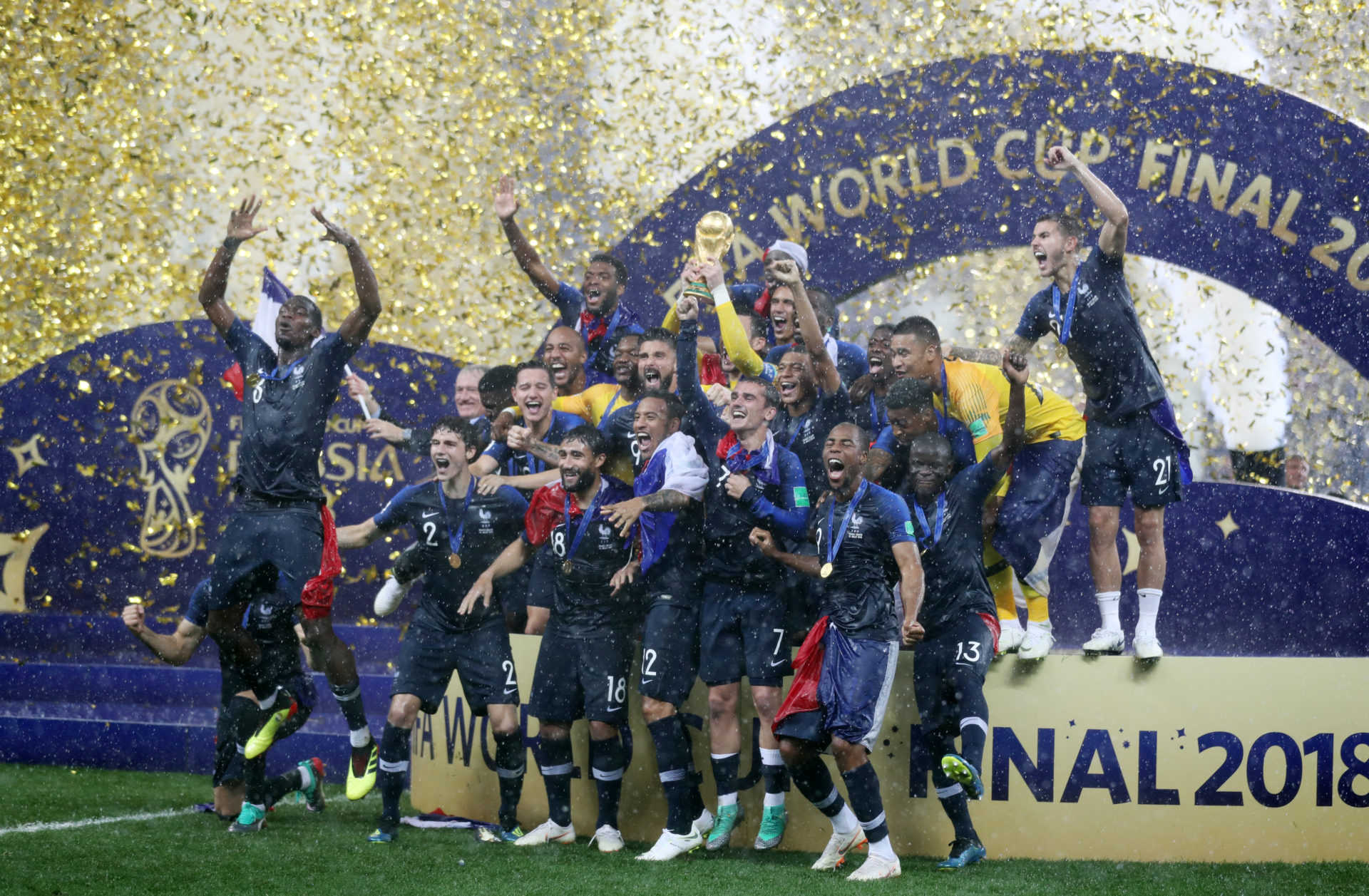
France travel to Qatar as the defending champions after Les Bleus won their second World Cup title at Russia 2018. Germany and Italy have secured four crowns, while Argentina and Uruguay also have two, like France. England and Spain are the only single-time champions.

So, why is the FIFA World Cup only every four years?
So, why is the World Cup only played every four years? Well, multiple factors make up why FIFA has traditionally organised the global competition on a quadrennial basis. One of the primary reasons is simply the sheer number of qualification games required for the event.
The qualification process for Qatar 2022 saw 865 games played to determine the 31 teams that would join the host nation. That includes every confederation’s group stage games, as well as all play-off fixtures. Only the host nation qualifies automatically for the World Cup.
A total of 211 FIFA members were eligible to qualify for the 2022 World Cup, although only 206 competed. Seven nations chose against entering any qualifying stage or later withdrew after playing some games. FIFA also banned Russia in response to its invasion of Ukraine.
The 2026 World Cup held in the United States of America, Mexico and Canada will also see FIFA increase the number of teams competing. A total of 48 nations will challenge in North America at the next edition. FIFA expanded its event to 24 sides in 1982 and to 32 in 1998.
Travel restrictions also limited the early World Cups from being more regular
Travel restrictions also limited the early World Cups being played more regularly with sides unable to get around as easily. In fact, only four European and two North American teams accepted FIFA’s invite to the inaugural World Cup in 1930 due to the lengthy sea journey.
Clubs also had to renounce their players for two months, which FIFA notes saw European nations stay away in 1930. Rimet also had to get personally involved to see at least four European countries in Belgium, France, Yugoslavia and Romania travel to South America.

FIFA also takes into account the time to build the infrastructure for a World Cup
FIFA also takes into account the time a host nation requires to build the infrastructure for a World Cup. Qatar won the right to host the 2022 edition back in 2010 and have had 12 years to prepare. The small Gulf state has carried out a lot of work in the in-between years.
A report by ESPN notes Qatar has spent $36bn (£31bn) building a metro system. It has also opened a five-lane motorway and built seven new stadiums to accommodate an expected 1.3 million visitors. Qatar officially notes a population of 2.9 million as of September 2022.
Could FIFA host a World Cup more often than every four years now?
While FIFA has traditionally stuck to hosting a World Cup every four years, it is considering a change to a biennial event from 2028. But a raft of football associations met the suggestion of the competition being every other year with opposition in favour of a quadrennial event.
The South American Football Confederation (CONMEBOL) branded FIFA’s suggestion of a biennial World Cup as ‘highly unviable’ in 2021, via Reuters.
A CONMEBOL statement added: “It could even put the quality of other tournaments at risk, both club and international. There is no sporting justification to cut the time period between World Cups.”
European governing body UEFA has also noted in a statement in 2021 that ‘there are real dangers associated with this plan’. It cited concerns over a biennial World Cup diluting the product, removing opportunities for the smaller nations and the sustainability for players.

Arsene Wenger is a driving force behind FIFA’s biennial World Cup idea
Former Arsenal boss Arsene Wenger is one of the leading forces behind FIFA considering a biennial World Cup. The Frenchman, now chief of global football development at FIFA, told beIN Sports in 2021 how the international calendar should only include meaningful events.
“Organise only competitions of meaning,” Wenger said. “Kick all the parallel competitions out of the game. People must understand what is at stake and only have games with meaning. If you look at the teams in the World Cups, usually the average age is 27 or 28.
“Because the World Cup is every four years there are very few chances to win it again because when they go back to the next World Cup they are 32 or 33. That’s why maybe we should organise the World Cup every two years.”
Receive exclusive football transfer news and updates twice a week to your mailbox