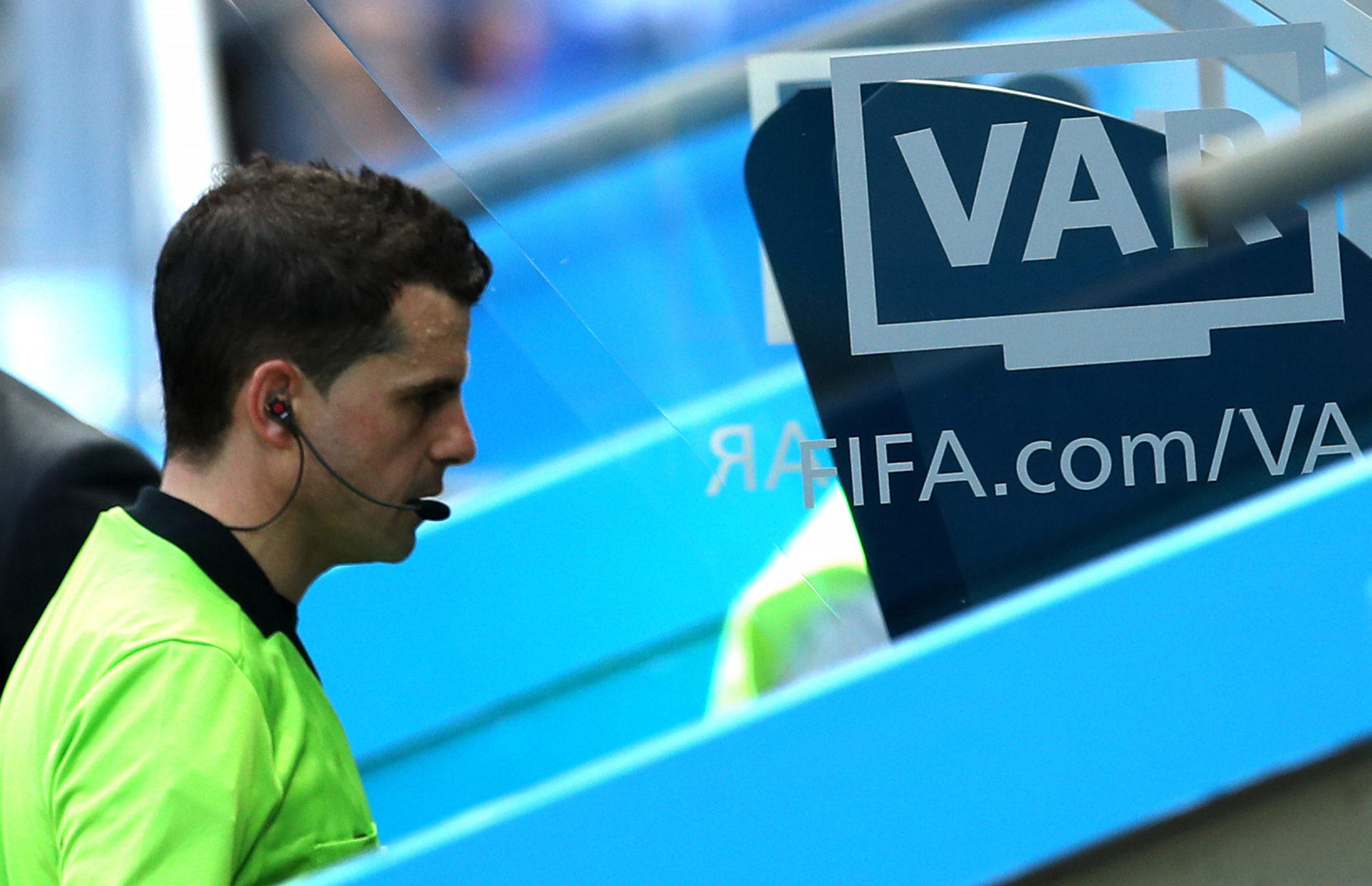

FIFA will bring Video Assistant Referees back to the World Cup in 2022 with VAR to be used in Qatar. The competition will also see semi-automated offside technology make its debut.
The VAR system first featured at the World Cup in 2018 as France won their second title in Russia. FIFA president Gianni Infantino viewed its introduction as a success and has worked with an array of partners to further enhance the technology as part of ‘The Vision 2020-23’.
As part of the improvements FIFA has sought to introduce to VAR ahead of the World Cup in Qatar includes the use of a semi-automated offside system. FIFA announced in July that the technology will make its debut at the tournament held across this November and December.

Will VAR be in use at the 2022 Qatar World Cup?
VAR will remain in use at the World Cup at Qatar 2022 following its introduction in Russia four years ago. Infantino heralded the technology as the end of offside goals in 2018. VAR officials used it to review over 440 incidents in 62 matches ahead of the final in Moscow.
“The word is progress, it is better than the past,” Infantino said in 2018, via quotes by the Business Standard. “VAR is not changing football, VAR is cleaning football, making football more honest and more transparent, helping referees take good decisions.”
France were the first nation to benefit from VAR being used at a World Cup at Russia 2018. Referee Andres Cunha awarded Les Bleus a penalty in the 58th minute against Australia in their first Group C tie. France also won a penalty in the final against Croatia through VAR.
Infantino also said referee decisions rose from a 95% accuracy rating to 99.2% with VAR at the 2018 World Cup. Any major European league not already using the technology prior to its success in Russia then rolled it out. Some leagues had begun using VAR prior to 2018.
The German Bundesliga and Italian Serie A had already introduced VAR technology for the 2017/18 season. La Liga followed after the Russia World Cup with Spain’s top-flight using VAR from 2018/19. The English Premier League did not use VAR technology until 2019/20.

How will the semi-automated offside technology work?
FIFA’s use of VAR at the 2022 World Cup in Qatar will differ from the Premier League’s use with the addition of a semi-automated offside system. The new element uses 12 dedicated cameras that will track the ball and all players to calculate their exact position on the pitch.
Each camera mounted underneath the roof of the stadium will take in data points 50 times per second. They focus on 29 data points including every limb of each individual player and extremities needed for making offside calls. The match ball will also provide a key element.
Adidas have created Al Rihla as the official match ball for the 2022 World Cup in Qatar. The ball will help the officials with tight offside decisions as it has an inertial measurement unit (IMU) sensor in its core. The IMU gives data to the VAR control room 500 times per second.
By applying artificial intelligence with the limb and ball-tracking technology the system will automatically alert the VAR officials to offsides. The notification will be sent the moment a player receives possession who was in an offside position when the ball was initially played.
The VAR will then review the offside call using the automatically selected kick point before informing the on-field referee. If confirmed, the decision is generated into a 3D animation from the clearest angle which shows the position of any players when the ball was played.

Will fans be able to see the outcome of the semi-automated offside technology?
VAR officials will screen the offside animation in the stadiums and make it available to every broadcast partner. FIFA expects the semi-automated offside process to last a few seconds to provide a faster and more accurate decision. It has already tested the process at events.
FIFA has tested the semi-automated offside technology at the 2021 Arab Cup and the 2021 Club World Cup. MIT Sports Lab, TRACK at Victoria University and ETH Zurich analysed and validated the data that FIFA collected over its online and offline trials of the technology.
Infantino sees the use of a semi-automated offside system at the 2022 Qatar World Cup as an evolution of VAR. The FIFA president further sees it as the clearest example of the work the governing body has been putting into advancing the use of technology within football.
He told the FIFA website in July: “At the FIFA World Cup in 2018, FIFA took the brave step to use VAR technology on the world’s biggest stage and it has proven to be an undisputable success. Semi-automated offside technology is an evolution of the VAR systems that have been implemented across the world.
“This technology is the culmination of three years of dedicated research and testing to provide the very best for the teams, players and fans who will be heading to Qatar later this year, and FIFA is proud of this work, as we look forward to the world seeing the benefits of semi-automated offside technology at the FIFA World Cup 2022.
“FIFA is committed to harnessing technology to improve the game of football at all levels, and the use of semi-automated offside technology at the FIFA World Cup in 2022 is the clearest possible evidence.”
Receive exclusive football transfer news and updates twice a week to your mailbox