
Typically in football, the biggest clubs have the biggest fan bases, and as such, the biggest stadiums to accommodate all their match-attending supporters. Barcelona play at the biggest football stadium in Spain, AC and Inter Milan play at the biggest football stadium in Italy, and Manchester United play in the biggest club football stadium in England – with the largest stadium, Wembley Stadium, playing host to the national team and cup finals.
I have done a few videos about stadiums – or stadia I should say, but I’ll use stadiums in the title and elsewhere since it is in much more common parlance – in the past, and as I’ve previously stated I do have a bit of an odd fascination with football grounds. The most recent stadia-related video I did was in regards to the 7 football grounds that are closest together, and that got a great reaction, so it seems I’m not a total freak in taking interest in stadiums across the globe.
“Your grounds too big for you!,” is a chant you will hear up and down the United Kingdom on a Saturday afternoon, directed at clubs whose stadiums have a large number of empty seats. Today I wanted to take that to an extreme, and take a look at some of the most disproportionate stadiums in relation to the clubs that play at them. So third tier teams with 1,000 fans playing in a 40,000 seater stadium, for example. I hope the concept is clear enough.
Here are 7 small football clubs who play at huge stadiums:
7. Seoul E-Land
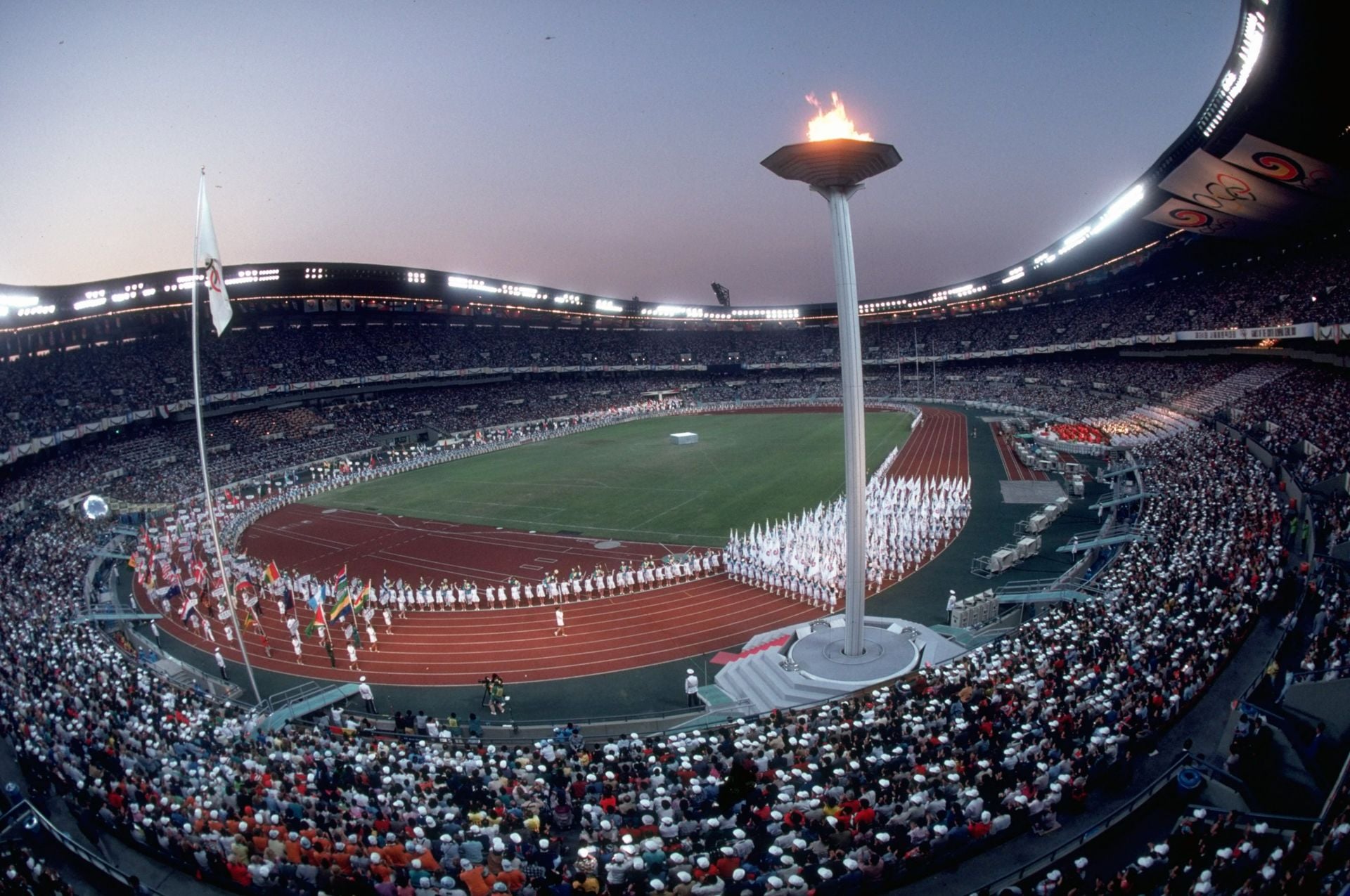
When a nation hosts the Olympic Games or the World Cup, especially one without much existing infrastructure for such sporting events, there tend to be some white elephants left behind. It’s happened in Brazil with the hosting of both of the world’s premier sporting competitions in quick succession, and it happened in South Korea and Japan when the two nations jointly held the 2002 World Cup. Seoul E-Land’s home ground named the Seoul Olympic Stadium was constructed, as its name suggests, as the centrepiece of the 1988 Summer Olympic Games in Seoul.
With a capacity of 69,950, the Seoul Olympic Stadium is an impressive venue, larger than Atletico Madrid’s recently constructed Wanda Metropolitano, Benfica’s Estadio da Luz and Arsenal’s Emirates Stadium. One might assume that it played host to one of South Korea’s footballing titans then, but one would be badly mistaken.
Seoul E-Land were only actually formed in 2014, and they play in the K-League 2, the second tier of South Korean football. In the 2018 season, the club averaged just 689 fans at the 69,950 capacity arena, meaning the stadium was less than 1% full on average. That has jumped to almost 3,000 this season, despite the fact the club are second bottom in the division, but running at close to 4% capacity is still pretty miserable, and more than worthy of a place in this seven.
6. Esporte Clube Flamengo
 Ipanema beach front and beach scenes. Barraca belonging to Edna and Sandra says the banner marking the place to rent beach chairs, umbrellas and an ice-chest for cold drinks. A Brazilian…
I mentioned Brazil whilst talking about Seoul E-Land, and it is to the largest nation in South America that we head for sixth place. Now most of you will have heard of a Brazilian club called Flamengo, who are six-time Brazilian champions, but we’re not talking about that Flamengo – who play their home games at Rio’s Maracana Stadium.
Esporte Clube Flamengo haven’t played in the top flight of Brazilian football since the mid-1980’s, and they currently play in the lowly Campeonato Brasileiro Série D, the fourth tier of Brazilian football. Despite this, the club has a stadium which could hold the combined capacities of Italian giants Juventus’ stadium and Premier League side Bournemouth’s with room to spare.
The Estádio Governador Alberto Tavares Silva, better known simply as Albertao, which is the clubs home, long had a capacity of 60,000. This was supposedly reduced to 44,200 a few years ago, but is now said to have risen back up to 52,296. God knows why, since the two teams who play there – fourth tier Flamengo and third tier River Atletico Clube – don’t have a prayer of filling it. River Atletico Clube have been out of the top flight even longer, since 1982, but I went with Flamengo since they play in the division below River. Flamengo’s average attendance figures don’t seem to be recorded, but their divisions average is said to be just over 1,000, which would be roughly 2% of the stadiums capacity. The Albertao’s ground sharers Flamengo and River do have a rivalry, known as Rivengo, a truncation of both clubs names.
5. Hwaseong FC
We’re straight back to South Korea in fifth place, with a stadium that World Soccer magazine described as the mother of all white elephants. The thinking behind building the Hwaseong Stadium in the village of Hyangnam-eup, which has a population of around 70,000, is difficult to comprehend. The country was already littered with large stadiums with no demand after the 2002 World Cup, many located outside of the most well-populated cities, so building another stadium essentially in the middle of nowhere made little to no sense.
They did it anyway, a great big whopping 35,270 seater in fact, with an unusual futuristic design which incorporates an integrated sports complex as well. As you can see, this is not a small stadium, but its regular occupants are a very, very small club. Hwaseong FC, who have a logo that would strike fear into the heart of any opposition fan, were only founded in 2013, with the sole purpose of giving this white elephant an occupant.
Competing in the fourth tier of Korean football unsurprisingly means they don’t attract thousands to their home games. Hyangnam-Eup village is only 30 miles from Seoul, where FC Seoul play, for passionate football fans, and it’s also not the easiest to access from those who live outside the region. Hwaseong average just a couple of hundred fans a game, meaning their training ground would be plenty big enough for their current level of demand, and the fact that they play at a stadium larger than half of all Premier League grounds is, put simply, rather daft.
4. ACR Messina
 Sulley Ali Muntari of Udinese gets away from Marco Zanchi of Messina during the Messina v Udinese Serie A game at the Stadio San Filippo on March 26, 2006 in Messina, Italy.
Mixing it up because we don’t want this seven to just consist of South Korean and Brazilian teams, ACR Messina have historically been a much bigger club than those mentioned in this video so far, but not anymore. In total, Messina have spent five seasons in the top flight of Italian football, but they now languish in Serie D, the basement division of league football in Italy, just about clinging onto their professional status.
1990 World Cup Golden Boot winner Salvatore Schillaci actually began his career and indeed spent the bulk of his playing days playing for Messina, turning out for the club in the fourth, third and second tiers. Messina have had multiple enforced relegations due to off-the-field discrepancies over the last decade or so, sometimes clawing their way back up the Italian footballing pyramid only to have their league status revoked once again.
The Stadio San Filippo, which opened in 2004 and holds 38,722 fans, replaced the clubs old 11,900 capacity Stadio Giovanni Celeste. In their first season at the stadium, Messina finished seventh in Serie A, their highest ever league finish, ahead of the likes of Roma, Lazio and Fiorentina. Crosstown rivals SSD FC Messina, recently renamed FC Messina, moved into the 11,900 capacity Stadio Giovanni Celeste, but the two clubs are now divisional rivals in Italy’s fourth tier. ACR Messina currently average around 1,500 fans at home games, whilst FC Messina average a little over 700, despite a capacity of over 50,000 between them.
3. Santa Cruz
Santa Cruz are a curious little Brazilian club who haven’t always been quite so little. Founded in 1914 by a group of boys all aged between 14 and 16, they were nicknamed ‘the team of boys’, and drew attention by pulling off some impressive results against more established local opposition. They were the first team in their region to allow black and Afro-Brazilians to play for the club, which helped them both on the pitch and in terms of support off it. In 1915, they recorded the biggest comeback in Brazilian football history, scoring six goals in 15 minutes to go from 5-1 down to 6-5 up. They are the club where Brazilian legend Rivaldo began his career, they were the opposition for Pele’s 1,000th appearance and they even beat the Brazilian national team once in 1934.
There’s a lot of Santa Cruz trivia then, and in the late 1960’s and 1970’s the club competed in the top flight of Brazilian football. Recife’s mayor wanted to give them a venue worthy of their stature, so the Estadio Jose do Rego Maciel – named after him but better known simply as the Estadio do Arruda – was constructed and opened in 1972. The stadium could hold 64,000 people, but Santa Cruz clearly felt that wasn’t enough, and in the 1980’s it was expanded with a fresh capacity of 110,000. Safety regulations meant the stadium never crammed that many in, with the record attendance of 90,200 coming for a friendly game in 1994 between Brazil and Argentina.
The stadium has since been reduced to a more modest 60,044 maximum capacity, but that’s still pretty enormous when one considers Santa Cruz’s standing. The club had a pretty miserable mid-2000’s, dropping all the way down to the fourth tier. They’ve since climbed to Serie C, the third tier of Brazilian football, but the Estadio do Arruda still looks more than a little out of place. The average attendance in the division is around 3,000, and the only chance Santa Cruz have of filling the ground is to draw Sport Recife in a cup game or to get back in the same division as their near neighbours and rivals.
2. Queen’s Park
 A general view during the Scotland training session at Hampden Park on June 7, 2017 in Glasgow, Scotland.
The relationship between Queen’s Park and Hampden Park is a fascinating one which dates back almost 150 years. The current Hampden Park was actually Queen’s Park’s third stadium, and their third named Hampden Park. When it opened in 1903, it was the biggest football stadium in the world, and along with Celtic Park and Ibrox, Glasgow had all three of the biggest grounds on Earth. It’s capacity was soon expanded from 100,000 up to its peak of 150,000 in the 1930’s, and the record attendance at the stadium was 149,415. The world’s largest attendance for a football match at the time, it remains the largest for an international match played in Europe to this day.
Queen’s Park are the oldest club in Scotland, having been formed in 1867, and they were one of the best sides in Britain at one time. Between 1874 and 1893, Queen’s Park won the Scottish Cup ten times, as well as reaching the English FA Cup final twice in the 1880’s. However, Queen’s Park’s strict amateur status has seen them fall away over the years. They haven’t played top flight football since the late 1950’s, and having celebrated their 150th birthday in 2017, they were relegated into the fourth tier in the 2017-18 season.
As well as their historical significance, Queen’s Park has more recently been the first professional club of Liverpool star Andy Robertson and legendary Manchester United manager Sir Alex Ferguson. With a current capacity of over 51,000, Hampden Park is the second largest stadium in Scotland, but it won’t be Queen’s Park’s home for much longer. Following the expiry of a long-term lease, the club agreed to sell the ground to the SFA in 2018 for £5 million. As part of that deal, Queen’s Park will move to the neighbouring Lesser Hampden, which is a little more suited to their 562 average attendance.
0. Honourable Mentions
There were loads of stadiums that could have featured in this seven but just missed out, and I’ll gladly take the opportunity to mention a few of them here. We’ll start with Daejeon Citizen FC, who play in South Korea’s K-League 2, but play in the 40,000+ capacity Daejeon World Cup Stadium. Then there’s fourth tier German outfit Alemannia Aachen, nicknamed the Potato beetles, who moved into the 32,960 New Tivoli stadium in 2007 for their only season in the Bundesliga since the 1960’s. In neighbouring Austria, SK Austria Klagenfurt are surely worthy of an honourable mention. Competing in the second tier of Austrian football, Klagenfurt’s Wörthersee Stadion can hold some 32,000 people.
Pyongyang City Sports Club most likely deserve a place in this seven, playing at the very large 50,000 capacity Kim Il-sung Stadium, but since North Korea don’t publish attendance figures technically for all we know they could be selling out every week – note; they’re almost certainly not. To rattle off a few others, the likes of Bari, Gateshead, Mohun Bagan, Selangor FA and Gwangju all warrant honourable mentions, and please do leave your own suggestions in the comments and subscribe to HITC Sevens. While you’re doing that though, here is your top spot…
1. Legiao FC
 Lucas Paqueta of Brazil prepares to take a corner kick during the International Friendly Match between Brazil and Qatar at Mane Garrincha Stadium on June 5, 2019 in Brasilia, Brazil.
Taking top spot when it comes to small clubs with ridiculously massive stadiums, Brazilian outfit Legiao FC really do not belong in a 69,349 capacity stadium. That stadium is the Estadio Nacional Mane Garrincha in the Brazilian capital of Brasilia. Named after Brazilian legend Garrincha, the stadium was redeveloped/reconstructed between 2010 and 2013 for the 2013 Confederations Cup and the 2014 World Cup at a cost of $900 million, making it the third most expensive football stadium on Earth and the most expensive outside of England.
The stadium was maxed out for all seven World Cup matches that it hosted as well as the opening game of the 2013 Confederations Cup, with close to 70,000 in attendance for every game, but it seemed little had been planned for after those games. $900 million is an awful lot of money for eight football matches, and despite initially looking fantastic, the stadium is already beginning to show signs of a lack of TLC.
No decent football teams in the region and no real appetite for live football means the Estadio Mane Garrincha rarely gets more than a couple of hundred fans in attendance for football games, a far cry from its 69,000+ capacity. Instead, it is now a bizarre sort of function room, wedding venue, local government meeting place, private party venue and everything in between. The stadium car park is even being used as a garage for the states Municipal buses. Both fifth tier Brasilia and fifth tier Legiao play at the massive stadium, but whilst Brasilia can get up to 1,000 fans at home game, Legiao rarely get more than a few hundred.
Receive exclusive football transfer news and updates twice a week to your mailbox