
Former Newcastle United, Manchester United, Real Madrid, Ajax and Barcelona players all feature.

The most popular sport on the planet, footballing stars are often world superstars or at least national celebrities, and as such it is not unusual for them to have things named after them. The most common things for footballers to have named after them are stadiums, techniques/skill moves and streets/roads. Such recognition is intended to honour players who have made great contributions to the sport or local area and to give them a legacy.
As such, most of the players who have something major named after them have achieved great things. For example, this seven includes Champions League and Ballon d’Or winners, with only a couple of the players not being or having been international superstars.
There are hundreds of streets and roads named after players that miss out and several stadiums, as such only particularly notable things named after players make the cut. The seven is in no particular order. Here are our top seven footballers with things named after them:
7. Cristiano Ronaldo (Galaxy)

There’s no way Cristiano Ronaldo could go a list of this ilk without being mentioned, and sure enough he isn’t. The Portugal and Real Madrid star is not known for being a particularly humble character, and it’s perhaps fitting that what is named after him – among other things – is an entire galaxy. The three-time Ballon d’Or winner has had a 13 billion year old galaxy which was recently discovered by astronomers named after him, or rather his brand, ‘CR7’.
6. David Beckham (Condoms)
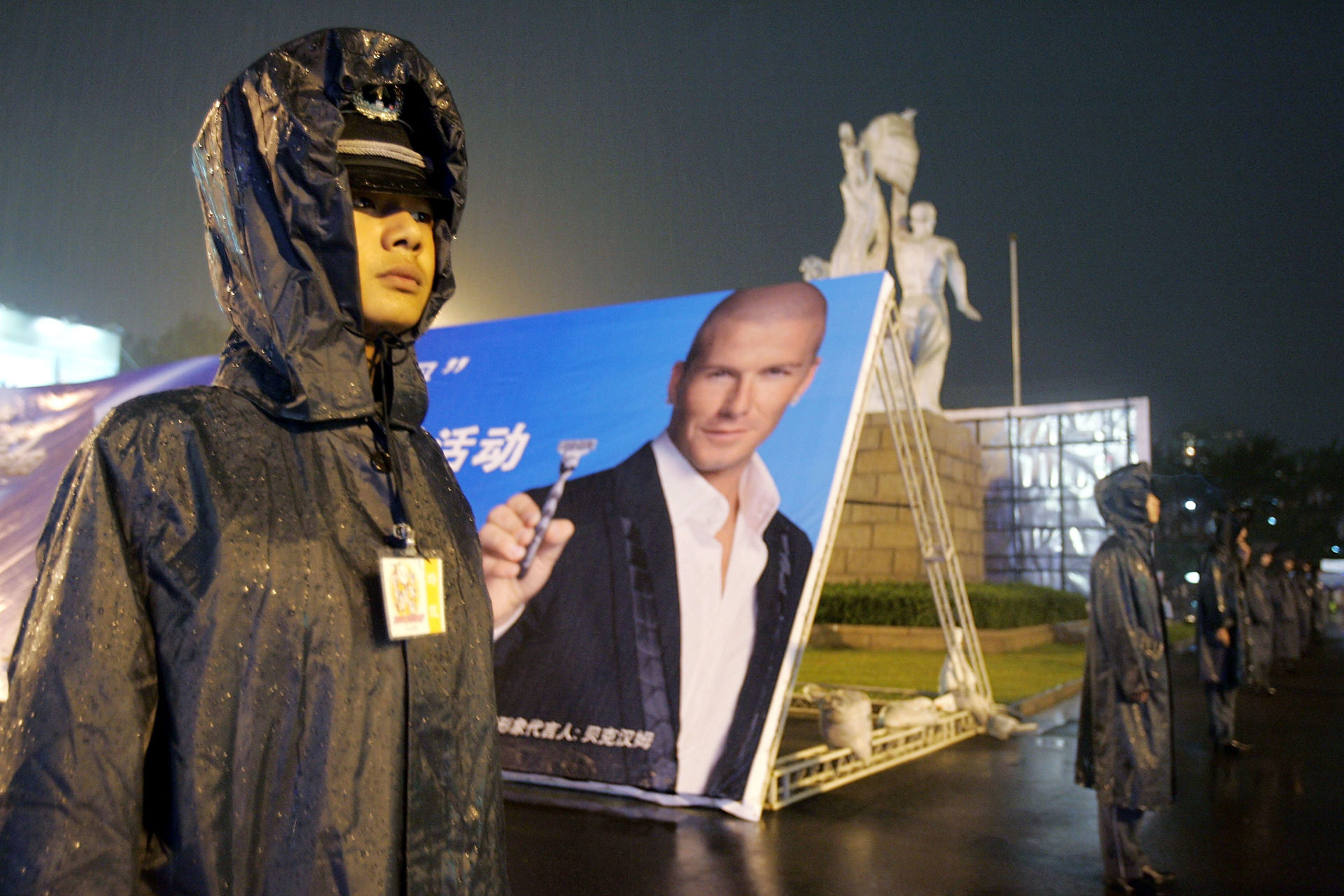
As hard as Ronaldo tries, the most recognisable and marketable footballer of all time is David Beckham, and he has put his name to numerous things, most notably fragrances and clothing lines. Less well-known, perhaps, are David Beckham condoms. The first time in which this happened Beckham had no official ties to the project. A struggling Chinese condom manufacturer changed their name to ‘Becoham’ before becoming the biggest selling condom manufacturer in China.
Unfortunately we can’t show you any pictures of Becks’ condoms, but a simply google search should do the trick. Beckham, who was the first Englishman to win league titles in four different countries, found himself associated with male contraceptives again in 2009, this time on bespoke condom packets sold in a Madrid museum.
5. Antonin Panenka (Penalty)
The ‘Panenka’ has become the accepted term for a penalty in which the player dinks the ball rather than striking it in the traditional fashion, in order to deceive the goalkeeper. It is named thusly because of former Czechoslovakia star Antonin Panenka, who is considered the first player to use the technique, and certainly the first to do it in a very high profile match.
It was the final of the 1976 European Championships, between Czechoslovakia and West Germany, when Panenka calmly stepped up in the most high-profile and tense moment to introduce the ‘Panenka’ penalty to the world and win his country the European Championships in the process.
4. Jackie Milburn (Steam Train)
Arguably the greatest player in Newcastle United history, Jackie Milburn was one of the earlier post-war greats of the English game, and spent the vast majority of his career at Newcastle. Milburn scored a total of 201 goals in 399 goals for Newcastle, making him the clubs all-time top scorer when he left in 1957, a record he would hold until being surpassed by Alan Shearer in 2006.
Milburn has a vast legacy and there is much named after him in the city of Newcastle, but none finer than the Jackie Milburn Locomotive which was named after him in 1991 before being restored in 2011. As well as his feats for Newcastle, where he is known as ‘Wor Jackie’, the three-time FA Cup winner also scored 10 goals in 13 caps for England.
3. Santiago Bernabeu (Stadium)
 An undated photo of the Santiago Bernabeu Stadium in Madrid.
While stadiums being named after players is far from rare, with Diego Maradona, Ferenc Puskas and Georgi Asparuhov just a few others to have had stadiums named after them, the Santiago Bernabeu Stadium deserves to be well-placed on this seven, given its enormity and renown. One of the world’s great football stadiums, the stadium has been the home of Real Madrid since 1947. With a current capacity of 81,044 and a record attendance of 124,000, the stadium is one of the most prestigious in world football. The Bernabeu is named after Santiago Bernabeu de Yeste, who spent 67 years at Real Madrid as player and president, transforming them from the second most successful team in Madrid to the most successful in Europe.
2. Jean-Marc Bosman (Transfer/Ruling)
Football fans will be well-acquainted with the phrase ‘on a Bosman’, meaning on a free transfer. Jean-Marc Bosman, who had a fairly unremarkable playing career, had a very remarkable court case, which he eventually won in 1995. The landmark decision made by the European Court of Justice named the ‘Bosman Ruling’ completely altered the way in which footballers’ contracts and transfers worked, allowing them to move freely once their contracts came to and end without a fee having to be paid, and hence the phrase ‘Bosman’ came into being. Bosman himself never felt the fruits of his labour, aged 31 by the time he won the case, and was recently sentenced to a year in prison for assault.
1. Johan Cruyff (Multiple)
One of the greatest players of all time, Johan Cruyff quite possibly has more things named after him than any other player in history. The Johan Cruyff Shield is the inaugural game of every Dutch season, a Super Cup between the winner of the league and the winner of the cup. The Johan Cruyff Award is the name of the Dutch Footballer of the Year award, and has been since 1984. 14282 Cruijff is an asteroid/minor planet named after Cruyff which was ratified by the IAU in 2010. Other things named after Cruyff include the Johan Cruyff Institute, the Johan Cruyff Foundation, Cruyff Courts, Johan Cruyff University and Johan Cruyff College.
The most famous of all though is the ‘Cruyff Turn’, named after the move that the Dutch legend used on a regular basis. Considered a basic skill today, it was revolutionary when Cruyff executed it to perfection in the 1974 World Cup against Sweden as the world watched on in awe. It immediately became ‘the’ skill to know, and from schoolboys to professionals the footballing world set about learning it. Cruyff won 23 trophies over his career with Ajax, Barcelona and Feyenoord, as well wining the Ballon d’Or three times and being named in the World Team of the Twentieth Century.
Receive exclusive football transfer news and updates twice a week to your mailbox